

 Haciyev Reşit
As the blockchain ecosystem rapidly evolves toward a multi-chain structure, security, finality, and interoperability have become some of the most critical challenges within this fragmented architecture. The growing need for interaction between different blockchains and rollups is making the limitations of existing infrastructures more visible. Espresso Network steps in at this exact point, aiming to provide a decentralized, high-performance, and secure consensus layer specifically designed for rollup-centric chains. Alongside its upcoming transition to Proof-of-Stake (PoS), the ESP token, which will form the economic and governance backbone of the network, has now been officially introduced. This transition is expected not only to enhance Espresso Network’s level of decentralization, but also to strengthen network security and long-term sustainability.
What Is Espresso Network Aiming to Achieve?
Espresso Network aims to create a fast, secure, and decentralized coordination layer between chains in a future dominated by multi-chain architectures. While rollup-based designs provide scalability advantages, their reliance on single sequencers introduces structural weaknesses such as single points of failure, liquidity fragmentation, and limited interoperability.
Espresso Network positions itself as a consensus system designed to eliminate these weaknesses and build a more resilient foundation for the rollup ecosystem. The network offers key features that enhance both rollup security and user experience:
- Decentralized sequencing: Removes dependency on a single operator, improving network security
- Fast and irreversible finality: Transactions become final within seconds
- Low-cost data availability: A more efficient and economical infrastructure for rollups
Through this approach, Espresso aims to simplify rollup scaling while strengthening cross-chain interactions, laying the groundwork for a more unified and sustainable multi-chain ecosystem.

HotShot Consensus and Technical Infrastructure
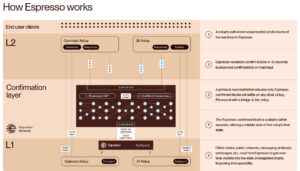
At the core of Espresso Network lies HotShot, a high-performance Byzantine Fault Tolerant (BFT) consensus protocol. Once a rollup block is confirmed by Espresso, it becomes irreversible (final). As a result, other chains and applications can rely on finalized state data within seconds rather than waiting minutes, as is often the case in traditional systems.
This fast and secure finality significantly improves cross-chain interoperability and provides a more predictable infrastructure for multi-chain applications. Espresso not only boosts performance but also simplifies trust assumptions between chains. The network already acts as a coordination layer for ecosystems such as RARI Chain, ApeChain, Celo, and Katana, while integrations with infrastructure leaders like Arbitrum and Caldera further reinforce Espresso’s vision of becoming a core coordination layer in the multi-chain ecosystem.
What Is the ESP Token and What Is It Used For?
ESP is the core economic mechanism that enables Espresso Network to operate in a permissionless and decentralized manner. Issued as an ERC-20 token on Ethereum, ESP plays a vital role in network security, incentive alignment, and protocol sustainability.
Key Use Cases of the ESP Token
- Proof-of-Stake (PoS) consensus: Validators must stake ESP tokens to participate in the HotShot consensus mechanism. Users who wish to support network security without running their own nodes can delegate their ESP tokens to validators, increasing decentralization and participation.
- Protocol fees: Fees for data processing, consensus operations, and infrastructure services on the Espresso network are paid in ESP. This makes ESP not only a staking asset but also the native payment token within the network economy.

ESP Token Supply and Distribution
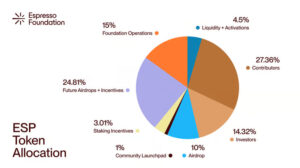
The initial total supply of ESP is 3,590,000,000 tokens. There is no hard maximum supply, as staking reward dynamics remain active.
Distribution breakdown:
- Contributors: 36%
- Investors: 32%
- Airdrop: 10%
- Future airdrops & incentives: 81%
- Foundation operations: 15%
- Liquidity & activations: 50%
- Staking bonuses & decentralization: 01%
Most allocations are subject to long-term vesting schedules.
Staking and Reward Mechanism
ESP holders can:
- Run their own validator nodes, directly participating in HotShot consensus and actively contributing to network security.
- Delegate tokens to existing validators, allowing users without technical setups to earn staking rewards.
The HotShot system dynamically selects the top 100 validators based on total stake to maintain network performance and security. The reward model is inspired by Ethereum’s structure, where reward rates gradually decrease as total staking participation increases. This approach helps control inflation while preventing sudden reward shocks for validators and delegators.
The Espresso Team
Espresso Network is led by an experienced team with deep expertise in blockchain infrastructure, cryptography, and distributed systems.
- Ben Fisch – Co-Founder & CEO Oversees Espresso’s strategic direction and product vision, with a strong background in distributed systems and blockchain infrastructure.
- Charles Lu – Co-Founder A core contributor to Espresso’s technical architecture, focusing on protocol design and scalability.
- Benedikt Bunz – Co-Founder & Chief Scientist A well-known figure in cryptography and zero-knowledge systems, responsible for the scientific foundations behind HotShot consensus and Espresso’s security architecture.

Airdrop and Participation Process
The registration process for the Espresso airdrop is currently live. Users can check eligibility via claim.espresso.foundation. After the claim period, staking and delegation options are expected to be rolled out gradually, further enhancing decentralization and user participation across the network.

Espresso Network stands out as a powerful infrastructure project addressing core challenges of finality, security, and interoperability in the multi-chain ecosystem. The ESP token serves as both the economic and governance backbone of the network, playing a crucial role in its long-term sustainability. The upcoming Proof-of-Stake transition and ongoing airdrop process are viewed as key catalysts that could significantly increase Espresso’s adoption and visibility within the broader blockchain ecosystem.
Official Links
- Website
- X (Twitter)
- Whitepaper
You can also freely share your thoughts and comments about the topic in the comment section. Additionally, don’t forget to follow us on our Telegram, YouTube, and Twitter channels for the latest news and updates.