

 Emre Yumlu
Today, artificial intelligence (AI) and blockchain technologies are redefining the boundaries of creative processes and the digital economy. When these two powerful technologies come together, they have the potential to transform not only production processes but also asset ownership, revenue models, and community participation. This is precisely where GaiAI (GAIX) comes in: an innovative platform that brings visual content creation, copyright, collaboration, and revenue sharing together in a decentralized manner. So, what exactly is GaiAI, and why does it attract attention in the worlds of crypto, AI, and the creative economy?
What is GaiAI (GAIX)?
GaiAI is defined as the world’s first creative AI and creative asset DAO. The platform takes visual production processes beyond just a “design” or “art” process; every creation, every prompt, and every visual is now evaluated as an on-chain asset. This makes the production process not just a means of expression but also a source of collaboration, contribution, and revenue.
The main goal of GaiAI is to build a decentralized creative economy. Here, users can create content using AI-powered tools while the ownership and revenue potential of these creations are recorded on-chain. This allows artists, designers, and creators to derive value from their work without relying on centralized platforms.
GaiAI’s Vision
GaiAI aims to establish a global on-chain creative asset network. The core approach ensures that creators have direct control over both the visualization and monetization processes. The platform’s vision rests on three key principles:
-
Decentralized Visual Production: Creators and users can produce visuals via AI without limitations from platforms or centralized authorities.
-
Participation and Revenue Access: Everyone can participate in creative processes, and production can generate income.
-
Visual Content as Assets: Every produced visual is recorded on-chain as an asset, with copyrights, usage history, and derivative records verifiable.
This approach addresses the shortcomings of traditional Web2 AI tools. In Web2, users mostly remain content consumers; the rights to their creations remain with the platforms, and long-term revenue mechanisms are limited. GaiAI flips this model: every user becomes a potential creator and revenue generator.
Core Products of GaiAI
The GaiAI ecosystem is built around three main modules:
1. Creative AI Agent
GaiAI’s AI agents offer users personalized creative assistants. These agents manage models uploaded by users, shared prompts, and derivative operations. Key features include:
-
AI agents that can be integrated into different applications
-
User-defined configurations such as style and knowledge domains
-
On-chain recording system suitable for revenue sharing
-
Future collaboration-based production (generate → derive → recall)
Through this module, GaiAI transforms AI agents into on-chain creative labor and creates a distributed microservice network.
2. Creative Asset Graph
GaiAI goes beyond the traditional visual library approach. It creates a graph for each creative asset, which includes the asset’s production record, metadata, and usage traces. This allows:
-
Tracking the production history and derivative links of each visual
-
Viewing the origins of models and prompts
-
On-chain attribution ensures personal records for creators
This system facilitates the derivation, reuse, and revenue-sharing processes of visual content.
3. Economic Incentive Engine
GaiAI’s distinguishing feature is that it not only encourages creation but also provides a revenue-generating system. The incentive mechanisms include:
-
Create-to-Mine: Each new creation earns points in the community revenue share.
-
Download-to-Earn: Creators earn income when their works are downloaded or reused.
-
Model/Prompt Licensing & Subscription: Creators earn recurring revenue from the use of their uploaded models or prompts.
This system operates in a “create → use → share → reward → recreate” loop, supporting not only visual production but also the AI-native creative asset economy.
GaiAI Market and Trend Analysis
The AI-powered visual production market is growing rapidly. According to Grand View Research, this market is expected to grow from $310 million in 2023 to $1.97 billion by 2028. Existing Web2 AI tools, such as Midjourney, have over 16 million users, showing the popularity of visual production.
However, current systems have structural shortcomings:
-
Unclear ownership: Rights to produced content remain with platforms.
-
No incentive mechanism: Creators cannot earn long-term revenue.
-
Lack of flexibility: Models, visuals, and styles cannot be fragmented or reused.
-
Low user participation: 90% of users are only consumers.
GaiAI aims to address all these issues and offers a decentralized creative economy model.
GAIX Tokenomics
The GAIX token is fully integrated into the economic flow:
-
Visual Production → dynamic GAIX cost
-
Subscription → recurring payment
-
Download Unlock → non-subscriber pays GAIX
-
Bounty and Task Participation → GAIX stake
-
Model Hosting → usage-based commission
Token sinks include reward pool injection, burn mechanisms, and treasury contributions. All rules will be shaped by open governance led by the community.
Reward Pool – Two-Layered Fair Distribution
-
Universal Pool (20%) → based on P-points (visual = 10 points, model upload = 100 points, derivative extra points)
-
Premium Pool (20%) → based on active downloads
Funding comes from subscriptions, future visual task markets, plug-in revenue, and token burns.
GaiAI Roadmap – The Future of the Visual Internet
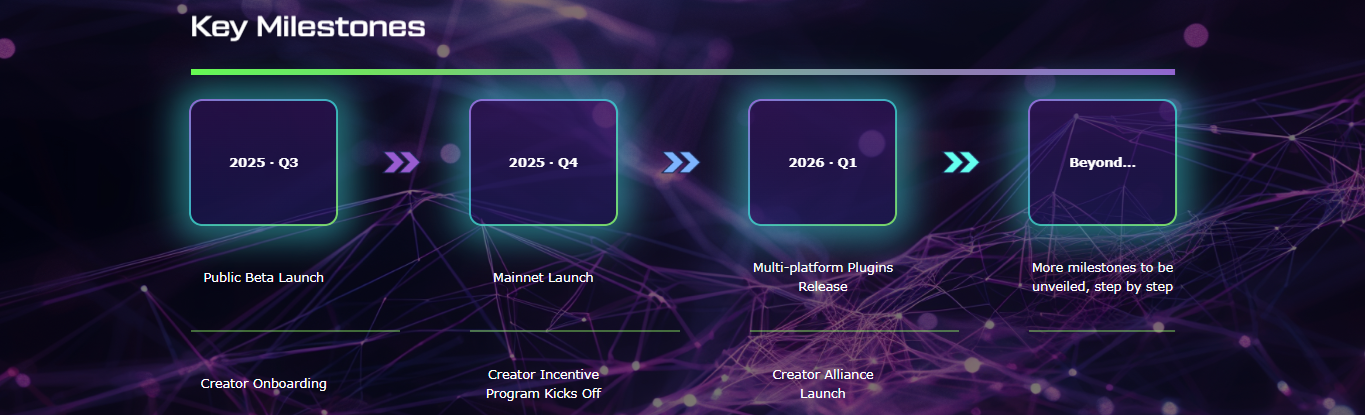
Q4 2025 – Infrastructure Setup:
-
Everyone can upload their own AI model.
-
AI agents can be registered.
-
Prompts and visuals are now linked.
-
Plugins that work across platforms will be distributed.
-
Creators’ visuals’ identity and rights will be tracked better.
Q1-Q2 2026 – User Explosion:
-
Creators will unite through the “Creator Alliance.”
-
A marketplace and freelance economy for visual tasks launches.
-
Users can sell, license, or pass on their works.
-
Digital identities (DID) will integrate with wallets.
Q2 2026 – Self-Sustaining Ecosystem:
-
Assets across different chains can be tracked.
-
The community will manage how AI agents operate.
-
Collaborative production flows will begin.
-
External projects will be connected to rewards.
Long-Term – Protocol Layer of the Visual Internet:
-
Standard visual formats and asset browsers will be developed.
-
A universal identity layer compatible with NFTs, digital IDs, and Web3 social networks will be created.
Investors and Partners
GaiAI has raised a total of $10 million:
-
Seed: $5M → led by Adelson Ventures
-
Series A: $5M → led by BGX
-
Participants: Lynch Crypto Partners, Mavs, Heemin Capital, Advokate Limited, Rzong Capital
Partners: Advokate, Satori Research, Heemin Capital, Storm Collectibles, Amante Lifestyle, Enterbay, SoleAddictt UNDS
Official Links
You can also freely share your thoughts and comments about the topic in the comment section. Additionally, don’t forget to follow us on our Telegram, YouTube, and Twitter channels for the latest news and updates.