

 Emre Yumlu
Blockchain technology is revolutionizing the creation and trading of digital assets. Metaplex (MPLX) stands out as a decentralized protocol on the Solana blockchain, designed for the creation, sale, and use of digital assets. Utilized in areas such as art, collectibles, gaming, and music, Metaplex dominates 99.9% of the Solana NFT market. So, what is Metaplex, how does it work, and what is its tokenomics structure? Let’s explore!
What is Metaplex (MPLX)?
Project is a decentralized protocol on the Solana blockchain that facilitates the creation, sale, and use of digital assets, particularly NFTs. Since its launch in August 2021, it has enabled the minting of over 20 million NFTs, reaching 5.9 million unique collectors, making it the largest protocol in the Solana ecosystem. With over $3.5 billion in primary and secondary sales, Metaplex has supported $990 million in transactions directly through programs like Token Metadata, Candy Machine, and Auction House.
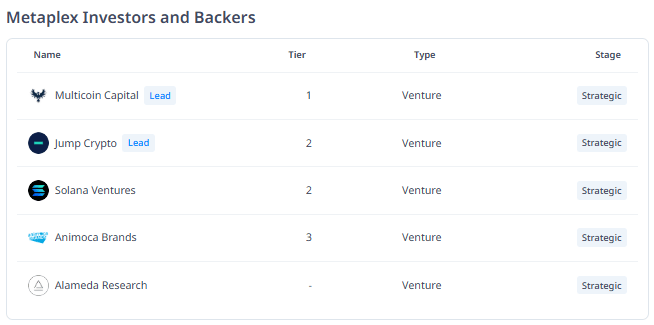
Metaplex has four core components: the Digital Asset Standard (DAS) defines schemas and behaviors for digital asset types; the Metaplex Program Library (MPL) implements these standards on Solana; the Metaplex Developer Platform simplifies integration with SDKs and tools; and the $MPLX token serves as the protocol’s governance and utility token. Integrated with platforms like Phantom, OpenSea, and Magic Eden, Metaplex is backed by prominent investors such as Multicoin Capital, Jump Crypto, and Solana Ventures.
Key Features of Metaplex (MPLX)
Company offers innovative features to empower the digital asset ecosystem:
1. Digital Asset Standard (DAS)
Provides schema and behavior definitions for art, collectibles, gaming, and music. It includes flexible storage (on-chain/off-chain), ERC-721 compatibility, and compression features.
2. Metaplex Program Library (MPL)
Supports NFT creation, sale, and distribution through programs like Token Metadata, Candy Machine, Auction House, Gumdrop, Hydra, and NFT Packs. For instance, Candy Machine has facilitated $940 million in primary sales.
3. Low-Cost Minting
Token Metadata enables NFT minting at 0.012 SOL. Compressed NFTs reduce costs to ~6 SOL for 1 million NFTs.
4. Developer Tools
Tools like Sugar, Solita, Amman, and Beet streamline Rust and TypeScript-based development. With 6.6k forks and 3.2k stars on GitHub, they are highly popular.
5. Escrowless Trading
Auction House enables direct NFT trading between buyers and sellers, with creators receiving royalties and marketplaces earning commissions instantly.
6. Community Governance
$MPLX token holders guide the protocol’s development and treasury fund usage through the Metaplex DAO.
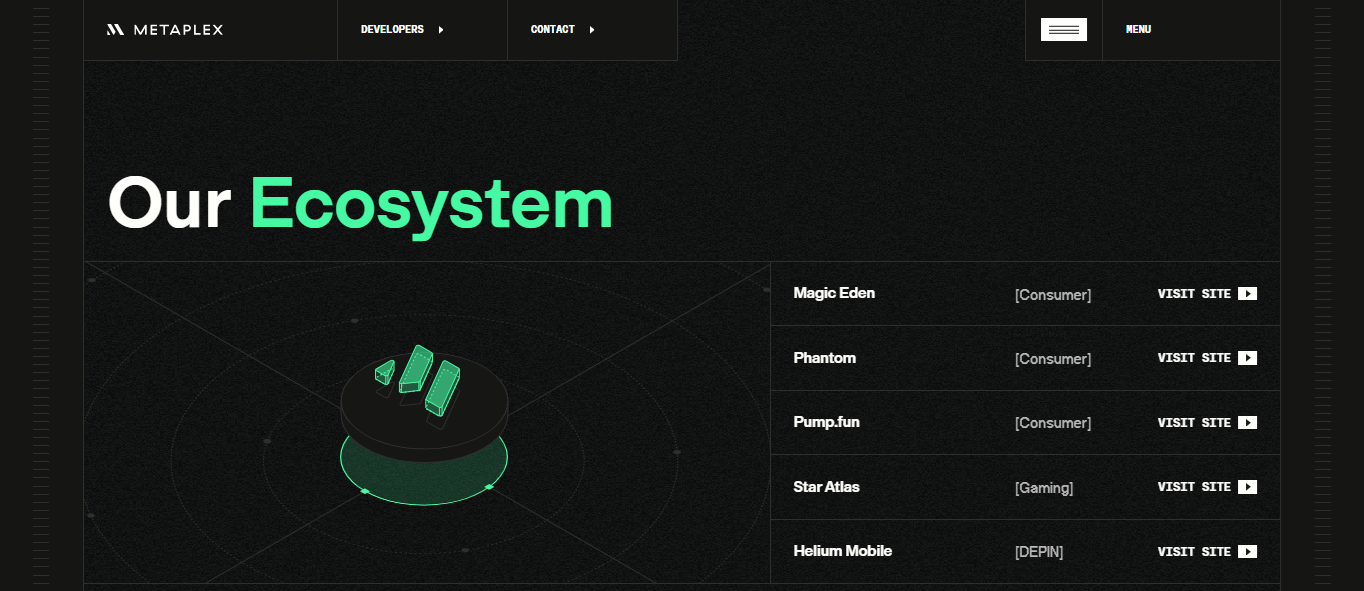
7. Broad Use Cases
Provides infrastructure for games (Aurory, Star Atlas), live events (Lollapalooza, Coachella), and marketplaces (OpenSea, Rarible).
How Metaplex (MPLX) Works
Company offers a comprehensive ecosystem from digital asset creation to trading:
-
Digital Asset Standard: Defines standard schemas (name, symbol, attributes) and behaviors (mint, transfer, burn) for NFTs.
-
Program Library: Token Metadata creates metadata, Candy Machine supports collection launches, and Auction House enables escrowless trading.
-
Compression: Bubblegum and Gummyroll programs allow low-cost NFT minting.
-
Airdrop and Distribution: Gumdrop facilitates large-scale airdrops using Merkle trees.
-
Developer Tools: SDKs (JavaScript, Python, iOS, Android) and CLI tools like Sugar simplify integration.
-
Governance: $MPLX token holders vote on protocol updates and treasury usage via the Metaplex DAO.
-
Storage: Supports off-chain storage options like Arweave, IPFS, S3, or Shadow Drive.
Benefits of Metaplex (MPLX) to Stakeholders
-
Creators: Low-cost minting and easy collection launches via Candy Machine.
-
Collectors: Liquid NFT trading on marketplaces like OpenSea and Magic Eden.
-
Developers: Rapid app development with SDKs and tools.
-
Community: Governance participation through the DAO.
Metaplex (MPLX) Tokenomics
$MPLX is Metaplex’s governance and utility token:
-
Token Name: MPLX
-
Total Supply: 1,000,000,000 MPLX
-
Standard: Solana SPL
-
Use Cases:
-
Governance: Protocol development and treasury usage via the DAO.
-
Utility: Access to exclusive NFTs, payments, and staking (in the future).
-
-
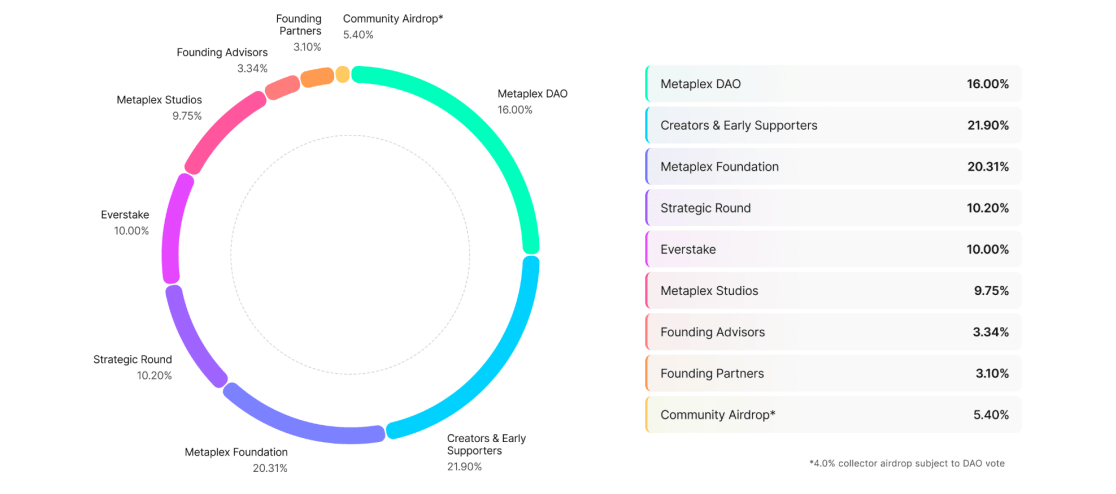
Distribution:
-
Creators and Early Supporters: 21.9% (219M, 1-year lock, then 1-year phased vesting)
-
Metaplex DAO: 16% (160M, unlocked)
-
Metaplex Foundation: 20.31% (203M, unlocked)
-
Strategic Round: 10.2% (102M, 1-year lock, then 1-year phased vesting)
-
Everstake: 10% (100M, 2-year lock, 1-year phased vesting)
-
Metaplex Studios: 9.75% (97.5M, 1-year lock, 2-year phased vesting)
-
Community Airdrop: 5.4% (54M, unlocked)
-
Founding Advisors: 3.34% (33.4M, 1-year lock, 1-year phased vesting)
-
Founding Partners: 3.1% (31M, 1-year lock, 1-year phased vesting)
-
-
Circulating Supply: Airdrop and DAO tokens are immediately usable; others are subject to phased vesting.
Metaplex Roadmap
Metaplex continues to expand the Solana NFT ecosystem:
-
2021: Launch, over 20M NFTs minted.
-
2022: 54M $MPLX airdrop, DAO establishment, Candy Guard, and Auctioneer launch.
-
2023-2025: Compressed NFTs, new programs, and Instagram integration.
Metaplex (MPLX) Partners
Company is supported by leading investors such as Multicoin Capital, Jump Crypto, Solana Ventures, Animoca Brands, and Alameda Research.
Metaplex (MPLX) Team
Metaplex is led by Nhan Phan (CTO and Co-Founder), Stephen Hess (Co-Founder), Dorian Brian Lee (CEO), and Brian Grace (General Counsel).

Official Links
You can also freely share your thoughts and comments about the topic in the comment section. Additionally, don’t forget to follow us on our Telegram, YouTube, and Twitter channels for the latest news and updates.