

 Emre Yumlu
Reddio (RDO) offers a scalable, secure, and efficient Layer 2 solution to overcome Ethereum’s limitations. Although Ethereum is a core platform for decentralized applications (dApps), it faces challenges with increasing usage demands. The answer to the question “What is Reddio (RDO)?” comes into play here. What is Reddio (RDO), and what does it do? Let’s explore in detail.
What is Reddio (RDO)?
Reddio (RDO) is an innovative Layer 2 platform that enhances the Ethereum blockchain. Its primary goal is to address Ethereum’s scalability, transaction speed, and cost issues, delivering a high-performance experience for developers and users. Reddio focuses on sectors like decentralized finance (DeFi), AI applications, and gaming, pushing the boundaries of blockchain technology. It offers developers flexibility, low latency, and high transaction capacity (over 10,000 TPS) while maintaining Ethereum’s security and decentralized structure.
To provide a more technical answer to the question “What is Reddio (RDO)?”, the platform is built on four key innovations:
- Parallel Execution and Asynchronous Storage: Reddio processes transactions in parallel and optimizes storage to eliminate delays caused by Ethereum’s sequential processing. This provides a critical advantage, especially for real-time applications.
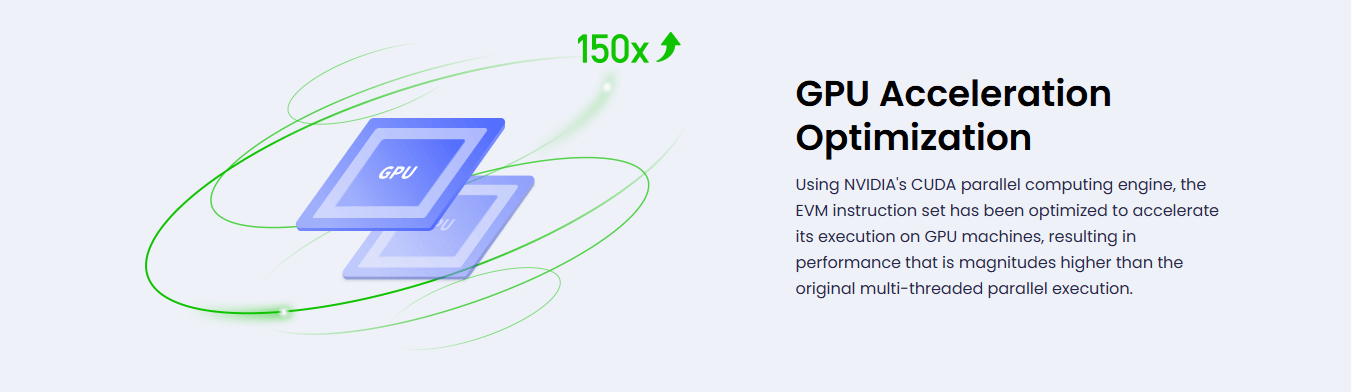
- CUDA-Compatible Parallel EVM: Reddio uses NVIDIA’s CUDA technology to run smart contracts in parallel on GPUs. This boosts transaction speed and capacity while ensuring full compatibility with existing Ethereum applications.
- Decentralized Modular Sequencer SDK: It offers developers a flexible toolkit to create customized Layer 2 and Layer 3 solutions, compatible with various virtual machines and consensus mechanisms.
- P2P GPU Network: It aggregates GPU resources worldwide, enabling secure and efficient on-chain execution of computationally intensive tasks like AI.
What Does Reddio (RDO) Do?
Reddio (RDO) provides a range of innovative solutions in the blockchain ecosystem, offering unique benefits to both developers and users. Here are the core answers to the question “What does Reddio (RDO) do?”:
- High Speed and Scalability: Reddio achieves over 10,000 transactions per second (TPS), solving Ethereum’s low transaction speed issue. This is ideal for high-volume applications like DeFi and gaming.
- Low Cost: By processing transactions on Layer 2, it significantly reduces Ethereum’s high transaction fees, providing a more cost-effective experience for users and developers.
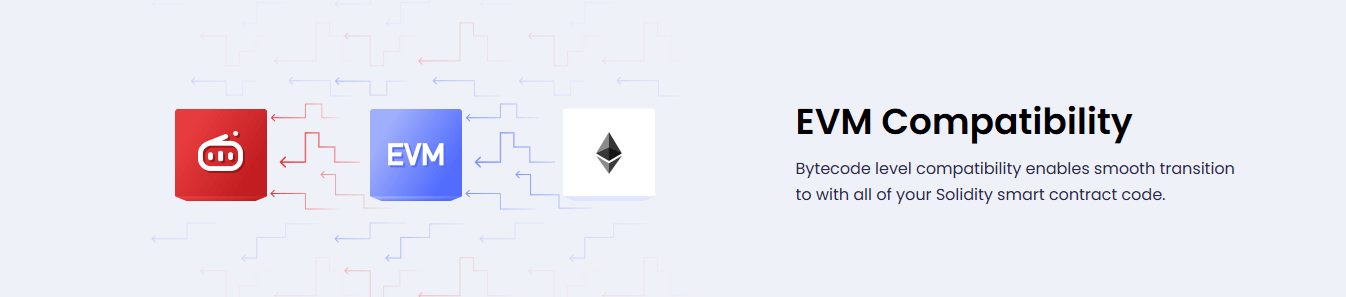
- Developer-Friendly Flexibility: The Modular Sequencer SDK allows developers to design custom blockchain solutions. Existing Ethereum applications can be easily migrated to Reddio, benefiting from high-performance advantages.
- Security and Decentralization: Reddio ensures a secure environment with zero-knowledge proofs and a decentralized sequencer model, critical for sectors like finance and gaming where reliability is key.
- AI and Blockchain Integration: Reddio enables on-chain execution of AI models, supporting innovative use cases in healthcare, finance, and autonomous smart contracts.
- Ideal for Gaming and DeFi: It provides fast, transparent, and cheat-proof infrastructure for fully on-chain games and decentralized exchanges (DEX).
Where is Reddio (RDO) Used?
Let’s take a look at Reddio (RDO) use cases:
- AI Agent Network: Reddio enables AI agents to perform complex tasks like scheduling, leasing, and on-chain inference with low latency.
- On-Chain AI Inference: It supports real-time data processing and decision-making on the blockchain, crucial for sectors like healthcare and finance.
- Decentralized Finance (DeFi): With high-speed transaction capacity, it powers on-chain order books and matching engines, enhancing DeFi platforms.
- Fully On-Chain Gaming: By processing game logic on the blockchain, Reddio offers a transparent, reliable, and cheat-proof gaming experience.
Reddio (RDO) Tokenomics and Distribution
Reddio (RDO) is a high-performance, decentralized Layer 2 solution that enhances Ethereum, offering scalability, speed, and low cost for AI, DeFi, and gaming. The RDO token is a core asset supporting the network’s operations, security, and governance. Let’s examine Reddio’s tokenomics structure and distribution strategy.
Reddio (RDO) Tokenomics
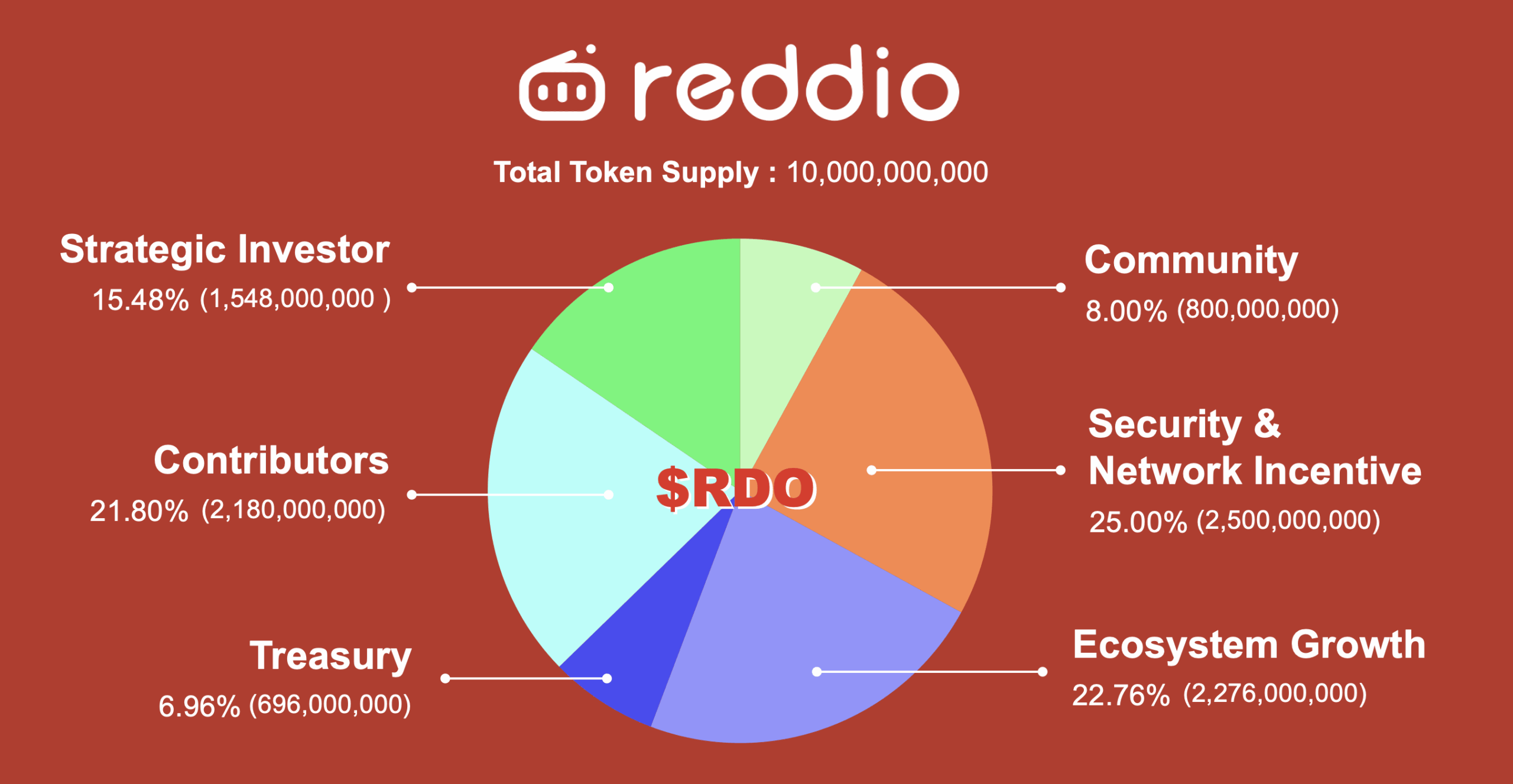
Reddio (RDO) tokenomics model is carefully designed to support network growth, security, and community participation. Here are the RDO token distribution ratios and purposes:
- Community (8.00%)
- Security and Network Incentive (25.00%)
- Ecosystem Growth (22.76%)
- Treasury (6.96%)
- Contributors (21.80%)
- Strategic Investors (15.48%)
Vesting and Distribution Philosophy
What is Reddio (RDO), and how does its tokenomics approach work? Reddio’s tokenomics philosophy is built on minimizing sell pressure and boosting market confidence:
- Cliff Periods: Cliff periods for contributors and investors ensure commitment.
- Linear Distribution: Gradual release encourages long-term participation and prevents sudden token dumps.
- Low Initial Supply: Only 19.00% of the supply enters circulation at TGE, supporting healthy market dynamics.
What is Reddio (RDO) Staking Mechanism?
Reddio (RDO) staking mechanism is designed to encourage long-term commitment from users and validators, enhance decentralization, and align economic rewards with platform participation. As part of the question “What is Reddio (RDO)?”, this mechanism supports the network’s Proof-of-Authority (PoA) consensus model. PoA requires validators to stake RDO tokens to participate in block production and network security.
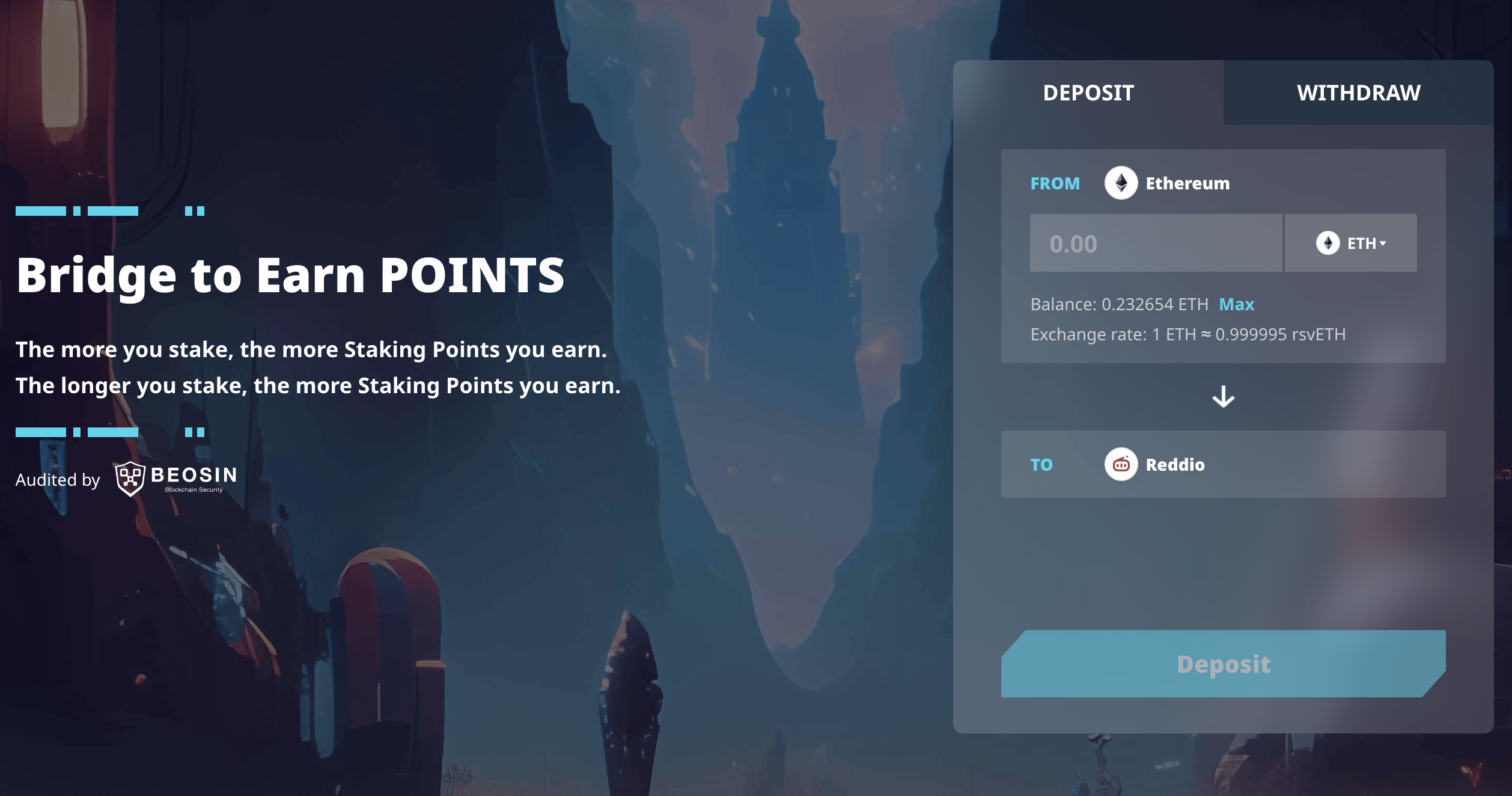
In Reddio’s tokenomics structure, a 2.5 billion RDO mining reward pool is spread over 10 years. This ensures transparency and predictability, offering a fair system for all staking participants. When asking “What does Reddio (RDO) do?”, this mechanism stands out as a key element supporting network security and sustainability.
Revenue Streams
Reddio’s economic model relies on diversified and optimized revenue streams for long-term sustainability. These sources fund platform operations and protocol development, as well as staking rewards, validator incentives, and token burns. In response to the question “What does Reddio (RDO) do?”, here are the main revenue streams:
Transaction Fees
- Definition: All interactions on the Reddio network, such as asset transfers, smart contract execution, or AI-powered application access, require users to pay gas fees in $RDO.
- Use Cases:
- Used to fund staking rewards.
- Up to 20% of each transaction fee is permanently removed from circulation (burn mechanism), reducing token supply and supporting long-term value growth.
- Scalability: As transaction volume increases, this revenue stream grows, directly tied to network growth.
Staking Points
The key to rewards on Reddio is Staking Points. These points are earned by staking tokens or inviting friends to stake. In response to the question “What is Reddio (RDO), and how does staking work?”, here are the ways to earn points:
Earn by Staking
- You accumulate Staking Points by locking your tokens in Reddio’s staking pool. The amount of points depends on the value and duration of the stake:
- Every 0.01 ETH staked = 1 Staking Point per day
- Every 50 USDT staked = 1 Staking Point per day
- Staking larger amounts grants chances to enter daily lotteries for bonus points:
- 0.1 ETH or 500 USDT staked = one daily lottery entry for bonus points
Earn by Referring Friends
- You earn points by inviting friends to Reddio and having them stake tokens.
- Example: If your friend stakes 10 ETH and earns 1000 points, you receive 100 points as a bonus (10% of their points).
Staking Leaderboard
- The Leaderboard offers additional rewards for top-ranked stakers. The top 100,000 stakers win special rewards, with exclusive bonuses for top positions.
Task Points
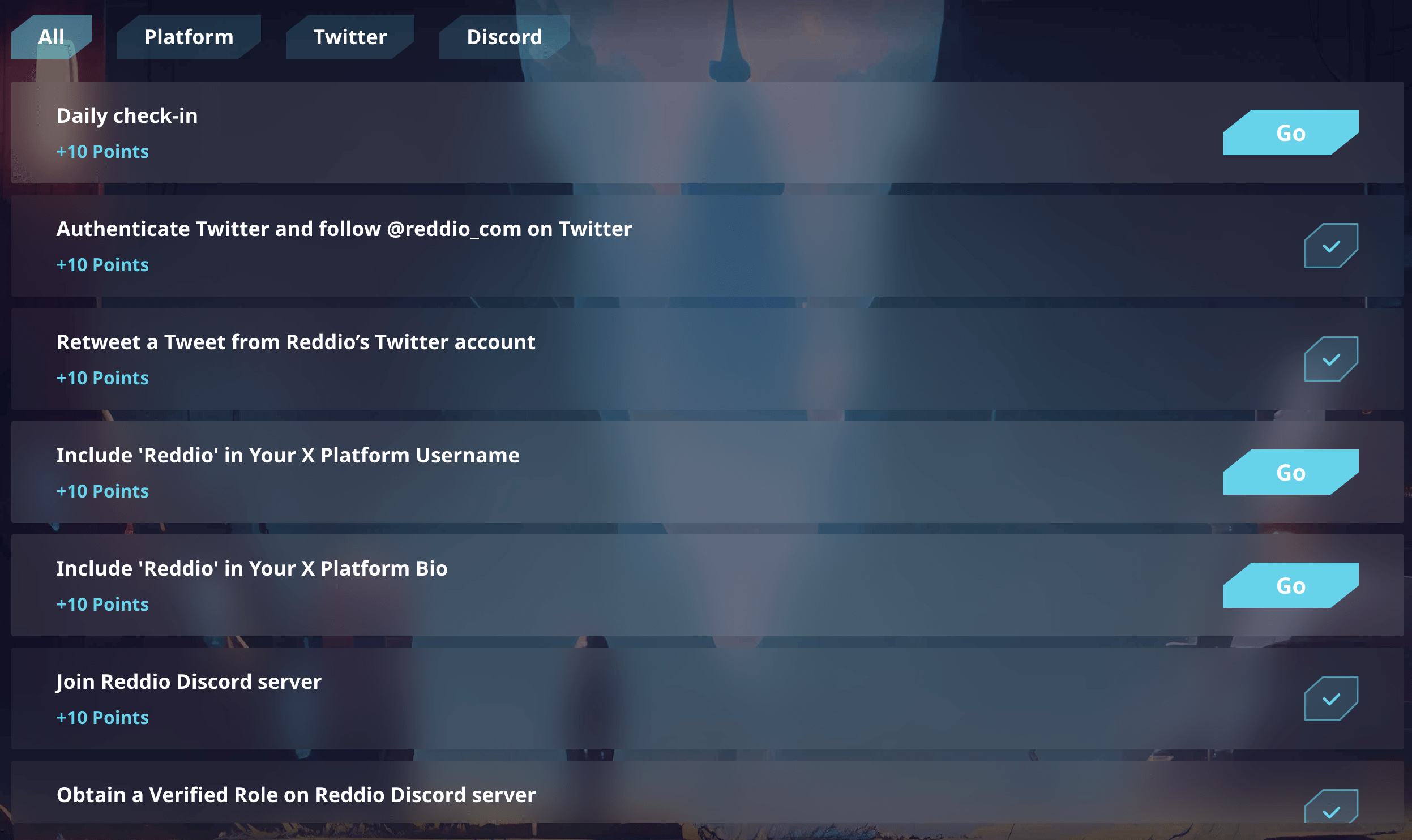
Task Points are earned by engaging in daily or special activities on the platform. This encourages continuous participation and interaction within the Reddio ecosystem.
Daily and Special Tasks
- Earn Task Points by completing various daily tasks:
- Social platform authentication (e.g., linking Twitter or Discord) = 10 points
- Interacting with Reddio’s social media (follow, retweet, share) = 10 points
- Joining the Reddio Discord server and obtaining roles (VERIFIED or ACTIVE) = 10 points
- Daily check-ins and community participation earn additional points.
Staking Lottery
- After staking tokens, you can join a daily lottery based on your stake amount, with a chance to win up to 300 Task Points.
- Example: Stake 0.1 ETH to enter a daily lottery with a chance to win up to 50 Task Points.
Card Collection and Gamification
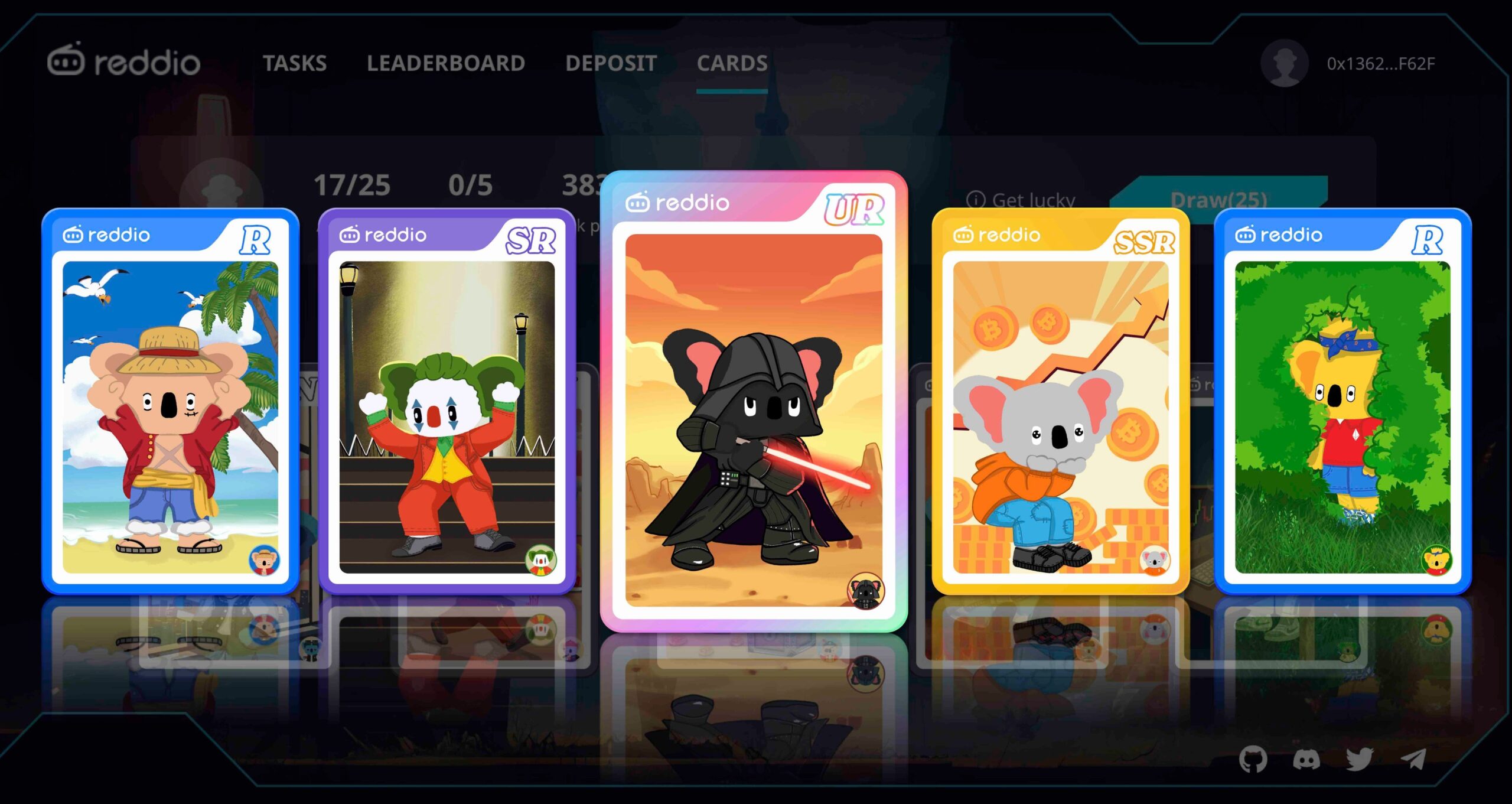
- During staking, daily lotteries allow you to win special cards. These cards have varying rarity levels (Common, Rare, Super Rare, Ultra Rare).
- Combination: Collect 5 cards of the same rarity to obtain Soulbound Tokens (SBT) with special benefits.
- Example: Collect 5 N cards to earn a Tier 1 SBT; 5 SSR cards grant a higher-level SBT with exclusive advantages in the ecosystem.
How to Get Started?
What does Reddio (RDO) do, and how to start staking? Here are the steps:
- Stake Your Tokens: Lock ETH or USDT in the staking pool to start earning points.
- Complete Tasks: Earn Task Points by completing daily challenges and social activities.
- Refer Friends: Invite others to Reddio to earn bonus points from their stakes.
- Redeem Rewards: Use points for special NFTs, token bonuses, and privileges.
- Collect Cards: Join lotteries to win cards, combine them, and obtain powerful Soulbound Tokens.
Reddio (RDO) Investors and Partnerships
Reddio (RDO) collaborates with Paradigm, Arena, Oak Grove Ventures, Paramita, Legends Group, Gate Ventures, Contribution Capital, Skyland Ventures, Good News Ventures, Wagmi Ventures, and Croc Capital. These partners support Reddio’s scalability, technology, and growth goals.

Reddio (RDO) Founder
Reddio (RDO) was founded by Neil Han. Neil Han gained 15 years of experience in Singapore across APAC and EMEA markets, with 7 years in engineering and 8 years in GTM for the developer market. As the third employee of Twilio APAC, Han also served as the GM of APAC and EMEA at PingCAP.

Official Links
You can also freely share your thoughts and comments about the topic in the comment section. Additionally, don’t forget to follow us on our Telegram, YouTube, and Twitter channels for the latest news and updates.