

 Yeliz Akmaca
zkPass is a decentralized oracle protocol that converts Web2 data into privately verifiable proofs that can be shared on the blockchain. Using an innovative technology called zkTLS, the project allows users to validate their personal Web data without intermediaries or exposing sensitive information.
With zkPass, users can prove data from HTTPS-based websites without OAuth or API keys, enabling secure cross-platform verification for Web3 applications.
Verifiable data domains include:
-
Legal identity (passport, driver’s license, national ID)
-
Financial records (bank balances, transaction history, credit scores)
-
Health information (medical records, prescriptions, genetic data)
-
Social and behavioral data (social media accounts, activity proofs)
-
Education and professional background (diplomas, certificates, employment history)
-
Digital assets and activities (gaming accounts, loyalty points, physical assets)
All proofs are generated locally on the user’s device, ensuring personal data is never shared with any third party. These proofs can be used across DeFi, digital identity (DID), DePIN, AI, governance, and more.

Team and Roles
-
Joshua Peng – Co-Founder & CSO: Leads the strategic direction and vision of the project.
-
Dr. B – Chief Scientist: Oversees academic research in Zero-Knowledge Proofs and cryptography.
-
Alvin – CTO: Responsible for protocol development and system architecture.
Investors and Partnerships
zkPass has received funding from major venture firms and ecosystem players.
Leading Investors:
-
Sequoia Capital China
-
HashKey Capital
-
Foresight Ventures
Partnerships focus on identity verification, financial applications, and privacy-critical integrations across Layer 1 and Layer 2 networks.
Project Vision and Working Principles
zkPass aims to preserve user control over private data while converting it into verifiable proofs.
The protocol’s core technology, zkTLS, extends the standard TLS protocol into a three-party structure to guarantee data source authenticity.
-
Data is processed locally on the user’s device.
-
Private proofs are generated without revealing the underlying data.
-
DeFi, enterprise verification, and Web3 applications can consume these proofs.
Governance
zkPass operates under a DAO-based governance model.
Token holders and validators vote on network decisions, protocol updates, and ecosystem incentives, enabling active participation from both individuals and institutions.
Roadmap
Q1 2025
-
zkTLS upgrades and mobile optimization
-
Security and ZK audits
-
zkPass SDK v2.0 and Proof UX Toolkit
Q2 2025
-
Launch of the Verifiable Data Portal
-
Consumer apps: DeFi credit scoring, airdrop verification
-
Expansion of the zkPass Node network
Q3 2025
-
Enterprise pilots (banking, education, healthcare)
-
Zero-Knowledge Compliance Suite
Q4 2025
-
$ZKP token launch and staking
-
Network scaling and validator expansion
Token Utility
-
Proof settlement and verification
-
Validator collateral and network security
-
Network contribution accounting
-
Enterprise API access and data verification
-
DAO governance and coordination
Token Details
ZKP is the native crypto asset powering the zkPass ecosystem.
- Token: $ZKP
- Total Supply: 1,000,000,000 ZKP
- Max Supply: 1,000,000,000 ZKP
- Circulating Supply: 201,660,000 ZKP
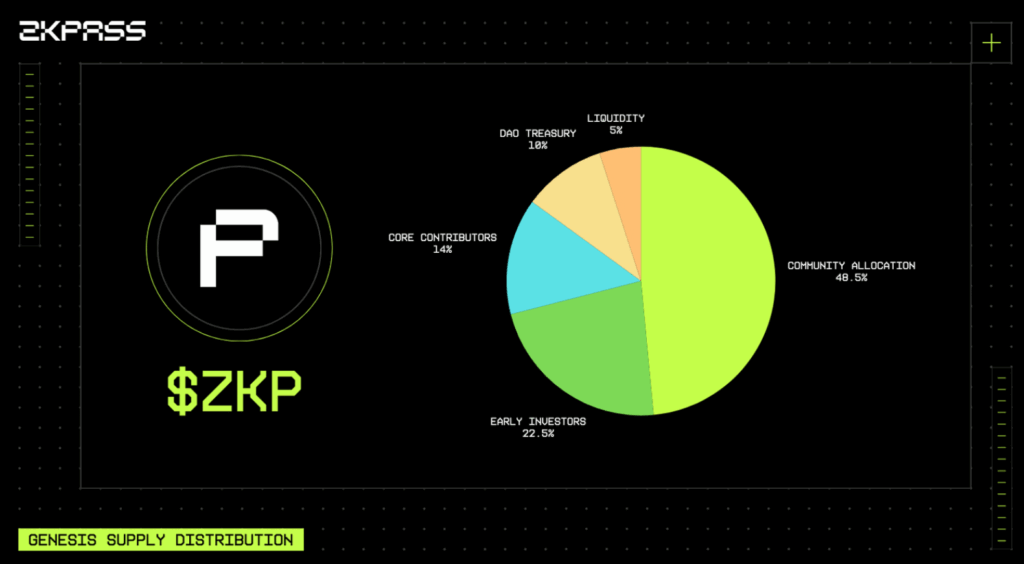
Token Distribution
-
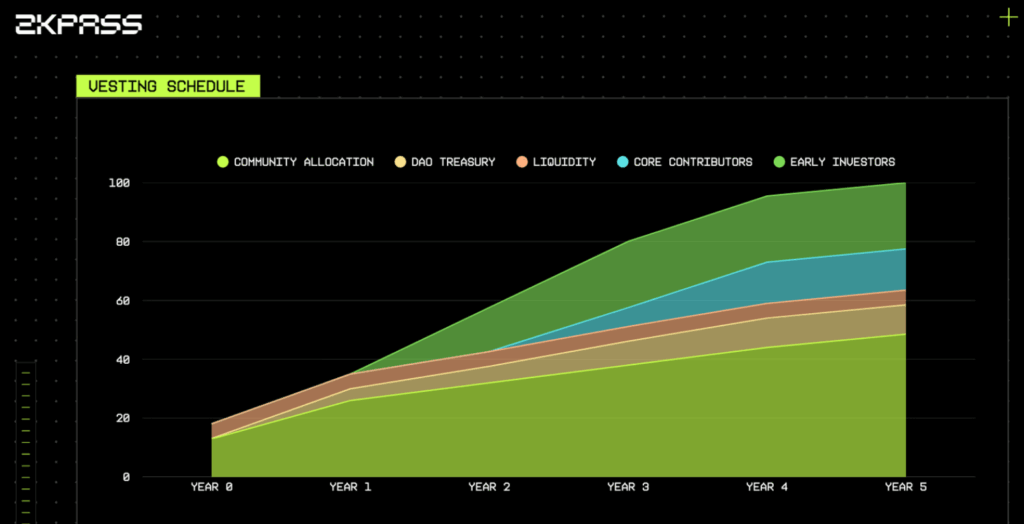
Community: 48.5% (12.5% at TGE, remainder via linear vesting)
-
Early Investors: 22.5% (12-month cliff, 18-month linear vesting)
-
Core Contributors: 14% (24-month cliff, 24-month linear vesting)
-
DAO Treasury: 10% (5-year linear vesting)
-
Liquidity: 5% (100% at TGE)
Ecosystem
zkPass creates a unified verification layer bridging Web2 and Web3.
Its ecosystem supports applications across AI, DeFi, enterprise verification, and digital identity solutions.
Key Features
-
Privacy Focused: Data stays on the device; only proofs are shared
-
Universal Compatibility: Works with all HTTPS websites
-
Anti-Cheating: Template-based validation prevents fraud
-
Fast Proof Generation: VOLEitH enables millisecond-level proofs
-
Trustless Attestation: zkSBT and decentralized verification mechanisms

Official Links
Also, you can freely share your thoughts and comments about the topic in the comment section. Additionally, please follow us on our Telegram, YouTube and Twitter channels for the latest news and updates.