

 Yeliz Akmaca
Bitcoin is falling because large wallets have shifted into gradual distribution while retail investors have not yet capitulated. The unrealized loss ratio rising to 24% has technically pushed the market into bear territory.
Recent bounce attempts are not a reversal signal for whales; instead, they’ve opened a liquidity window for distribution. Retail investors’ “buy-the-dip” optimism has become the primary exit liquidity. This clarifies the on-chain answer to “why is Bitcoin falling”: selling pressure persists, and optimism hasn’t fully unwound. $63,007 is being watched as support, while $71,672 stands as short-term resistance. Current rallies still fail to confirm a sustained trend reversal.
At the time of writing, Bitcoin is trying to hold around $69,500. On-chain data suggests this balance remains fragile. Whale pullback, rising unrealized losses, and retail investors maintaining positions continue to keep pressure alive. In other words, it’s not just price action — market psychology hasn’t fully reset.
Bear Market Intensity: What Does the Unrealized Loss Ratio Signal?
During Bitcoin’s drop toward $60,000, the Relative Unrealized Loss ratio climbed to roughly 24%. This sits well above the classic bull–bear transition zone.
Put differently, the market is technically in bear territory. Historically, levels above 50% have marked full capitulation. The current reading points more toward an active surrender phase. Selling pressure is widespread — but not exhausted.
Which suggests the search for a bottom may not be over. Volatility could remain in play.
Retail Accumulates While Large Wallets Distribute
A notable divergence is emerging in supply distribution.
Wallets holding less than 0.01 BTC are steadily increasing their share of total supply. This group typically reacts emotionally to price swings, yet is now quietly accumulating.
At the same time, wallets holding between 10 and 10,000 BTC show mild but consistent distribution. The contrast matters. Social sentiment remains broadly bearish, yet retail investors still view current levels as value zones. Optimism hasn’t been fully flushed.
Historically, deeper bear markets coincide with retail capitulation. That point hasn’t arrived. Until it does, sustained upside momentum remains difficult.
Network Activity Surprises: New Addresses Surge
New Bitcoin addresses jumped roughly 37% over the past week. At first glance, this looks positive. But in bear markets, such spikes don’t always signal adoption.
Much of this influx tends to come from small-scale participants seeking volatility plays. While new users may support price during consolidation, they don’t shift market control. Network growth continues — power dynamics do not.
Macro risk-off conditions could easily overpower even strong on-chain activity.
BTC Price Levels to Watch
Aggressive buying near $63,007 prevented a deeper breakdown below $60,000, confirming solid demand in that zone. Still, downside risk remains elevated.
Internally, $66,700 has been reclaimed, but this micro-structure break alone doesn’t signal reversal. With funding rates negative, opening additional shorts carries risk. The market is compressed, and weekend conditions could trigger a sharp short-squeeze wick.
Key levels ahead:
-
$63,007 – primary support
-
$71,672 – first major resistance
-
Weekly close above $73,880 – critical
-
If structure holds, $79,200 emerges as a medium-term technical target
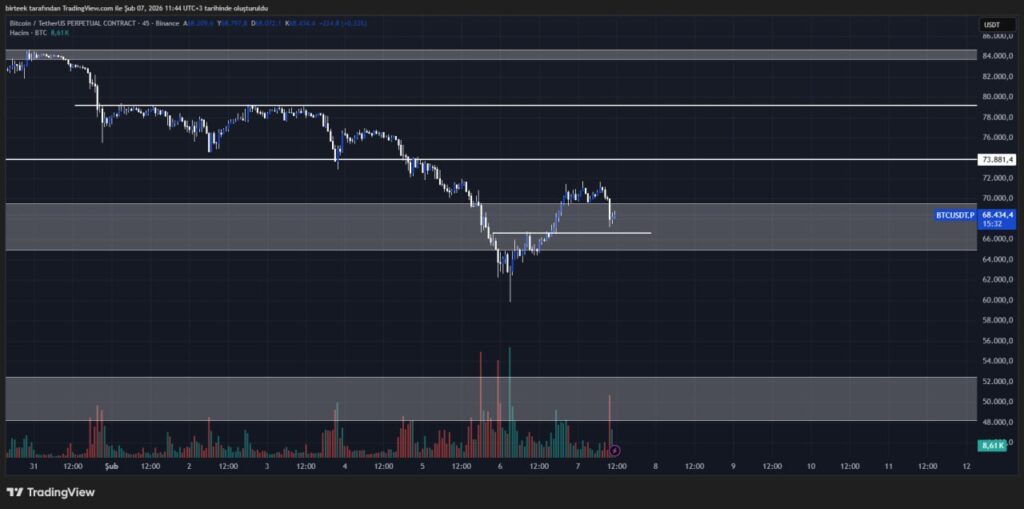
If weekly price action leaves only a wick and closes higher, the following week could start on firmer footing.
For now, the market is still searching for balance.
The information and commentary in this article do not constitute investment advice.
Also, in the comment section, you can freely share your comments and opinions about the topic. Additionally, don’t forget to follow us on Telegram, YouTube and Twitter for the latest news and updates.