

 Yeliz Akmaca
Realized losses on the Ripple XRP network have surged to $1.93 billion, marking the highest level since 2022. On-chain data shows that investors have been selling at a loss on a large scale. However, historical patterns suggest that similar spikes in realized losses have often reduced selling pressure and created conditions for strong price recoveries in the following months. The current data reflects a period where short-term fear and medium-term recovery potential coexist.
On-Chain Data Shows the Largest Loss Wave in 39 Months
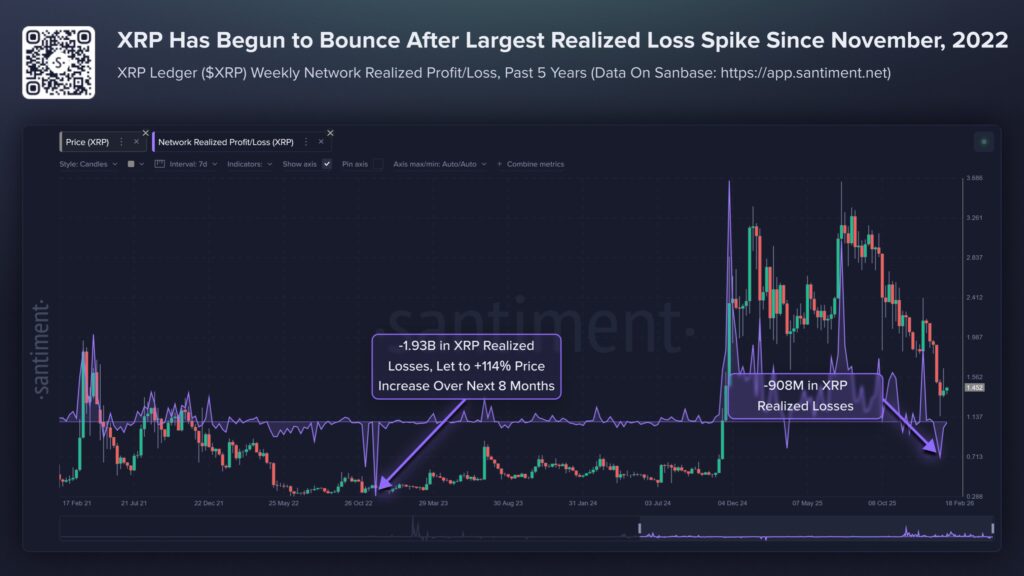
According to on-chain analytics firm Santiment, XRP recorded $1.93 billion in weekly realized losses as of February 21. This level was last seen approximately 39 months ago. The magnitude alone is significant, but its implications are even more important.
Realized losses occur when investors sell assets below their original purchase price. This metric reflects capitulation, meaning investors are no longer willing to hold their positions and instead accept losses.
During these periods, market psychology shifts noticeably. Confidence weakens. Panic selling accelerates. And in many cases, the market quietly enters a bottom formation phase.
Notably, the last time XRP experienced a realized loss spike of this magnitude, the price increased by 114% over the following eight months. While this does not guarantee a repeat performance, it establishes a historical precedent that market participants cannot ignore.
Selling Pressure May Decline After Weak Holders Exit
Large realized loss events often flush out weaker market participants. Short-term holders and investors with higher cost bases exit their positions. While this initially appears negative, it can structurally reduce overall selling pressure.
With fewer sellers remaining, the market requires less buying volume to stabilize and potentially move higher. Even moderate demand can shift price direction once capitulation subsides.
Santiment noted that realized profit and loss data helps identify emotional extremes in the market. Periods of excessive fear frequently occur near market bottoms. Not always, but often enough to remain a critical signal.
Analysts Outline Aggressive XRP Price Targets and Cycle Structure
Several market analysts have shared bullish projections for XRP. Analyst CryptoBull identified price targets of $13 for March, $27 for April, and $70 for May, outlining a three-month projection window based on historical performance and structural trends.
These forecasts may appear highly optimistic, but they are rooted in cycle-based analysis.
Analyst Egrag Crypto examined previous macro cycle bottoms. XRP reached a cycle low of approximately $0.10 in 2020 and $0.28 in 2022. This represents a 2.8x increase between cycle bottoms.
Applying the same growth ratio, the next macro bottom could form between $0.75 and $0.85. This approach assumes that each market cycle establishes a structurally higher price floor for XRP.
While cycle models cannot predict exact timing, they provide insight into long-term structural progression.
Institutional Developments Quietly Support XRP Demand
Beyond on-chain metrics and technical analysis, institutional developments may be contributing to XRP’s underlying demand.
Japanese financial giant SBI Holdings recently issued 10 billion yen in on-chain bonds. The issuance, valued at approximately $64.5 million, offers XRP rewards to investors. This represents an important step in integrating XRP into structured financial products.
Additionally, European banking group Société Générale launched its euro-pegged stablecoin, EUR CoinVertible, on the XRP Ledger as part of a multi-chain strategy. This move expands the institutional utility of the XRP Ledger.
Spot XRP ETFs have also recorded net inflows for three consecutive weeks, although the pace of inflows has slowed recently. The continued inflows suggest that institutional interest remains present.
XRP Shows Early Signs of Short-Term Stabilization
At the time of writing, XRP was trading at $1.44. Despite declining more than 25% over the past month, the asset recorded a 1.55% gain within the past 24 hours.
This movement may appear modest, but its timing is significant.
Price stabilization following major realized loss spikes often signals a shift in market structure. As selling pressure weakens, the probability of recovery gradually increases.
XRP has also moved in correlation with Bitcoin during the broader market recovery, suggesting macro sentiment remains a key influence.
What the Data Suggests About XRP’s Next Phase
The scale of realized losses indicates that a significant portion of weaker holders may have already exited the market. Historically, similar conditions have preceded strong recovery phases.
However, market cycles rarely repeat with perfect symmetry. The structure may be familiar, but the timing can vary. Recovery may occur quickly, or it may take several months.
Current conditions suggest fear has reached elevated levels. And in financial markets, extreme fear often appears near turning points.
For XRP, the central question is no longer whether capitulation has occurred, but when sustained recovery momentum will begin.
Disclaimer: This content is provided for informational and market analysis purposes only and does not constitute investment advice. Cryptocurrency investments involve risk, and readers should conduct their own research before making financial decisions.
You can also freely share your thoughts and comments about the topic in the comment section. Additionally, don’t forget to follow us on our Telegram, YouTube, and Twitter channels for the latest news and updates.