

 Haciyev Reşit
In the world of cryptocurrency, Bitcoin is indisputably the leader in terms of security and decentralization. However, increasing user interest and transaction demands have exposed Bitcoin’s scalability issues. Rising transaction fees and block space limitations make it difficult to develop more complex applications on Bitcoin.
Citrea is the first Bitcoin rollup project to address this problem using zero-knowledge proofs (ZK-proofs). By leveraging Bitcoin as both a settlement layer and a data availability layer, Citrea enhances on-chain verifiability. This allows the construction of more complex and scalable applications without compromising Bitcoin’s security.

Key Features of Citrea
- The First Rollup Solution for Bitcoin
Citrea is the first rollup solution implemented in the Bitcoin ecosystem. This model, commonly used in the Ethereum ecosystem, aggregates thousands of transactions into a single batch, increasing scalability and reducing costs. - EVM Compatibility
Citrea is fully compatible with the Ethereum Virtual Machine (EVM). This allows developers who are already building on Ethereum to port their applications to the Bitcoin network with minimal changes. - Two-Way Peg with BitVM and Clementine
Citrea uses a trustless, zero-knowledge proof-supported two-way peg mechanism called Clementine.
This setup allows users to transfer Bitcoin to Citrea (peg-in) or withdraw it back (peg-out).
With BitVM integration, bridge operations are executed with minimized trust. Unlike traditional federation-based bridges, only a single honest validator is required.
- On-Chain Data Availability
Citrea leverages Bitcoin’s block space to provide on-chain data availability. This ensures a more efficient transaction process while preserving Bitcoin’s censorship resistance and security.
Funding and Investor Support
Citrea has quickly attracted attention from prominent investors:
- Seed Round: $2.7 million raised, led by Galaxy, with participation from Delphi Ventures, Eric Wall, Anurag Arjun, and others.
- Series A: $14 million raised, led by Founders Fund, with participation from Maven 11, Mirana Ventures, and other funds.
These investments demonstrate confidence in both Citrea’s technical infrastructure and its long-term vision

Citrea’s Founding Team
Citrea is being developed by Chainway Labs. The core team consists of:
- Orkun Mahir Kılıç
- Esad Yusuf Atik
- Murat Karademir
The team members have many years of experience in blockchain and cryptography.

Scalability Challenges Faced by Bitcoin
High Demand and Rising Fees: Bitcoin’s growing popularity has created intense competition for block space, driving up transaction fees.
Limited Transaction Capacity: Due to Bitcoin’s limited block size, not all transactions can fit into the blockchain.
Shortcomings of Existing Solutions: While Layer-2 solutions like the Lightning Network are effective for payments, they fall short for DeFi and complex applications. Sidechains, on the other hand, cannot provide the same security guarantees as Bitcoin.

Execution Layer That Transforms Sidechains
In the Bitcoin ecosystem, sidechains have long been used to address scalability issues. These sidechains enable additional applications and faster transactions while preserving Bitcoin’s security and core consensus rules. However, traditional sidechains have some critical limitations:
- Security Trade-Offs: Most sidechains do not offer Bitcoin’s full security. Users often rely on additional federations or trust-based participants for transaction validation.
- Off-Chain Transaction Complexity: Since sidechains are not directly integrated with the Bitcoin blockchain, they lack full data availability and on-chain verifiability.
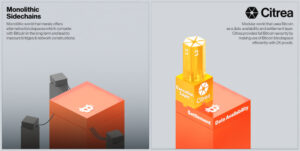
- Monolithic Structures: Traditional sidechains typically operate as a single execution layer and lack modularity, making it difficult for more complex applications to run securely on Bitcoin.
Useful Information
Citrea is the only execution layer that performs transactions directly on Bitcoin. Every transaction on Citrea is fully secured using zero-knowledge proofs and verified by Bitcoin. Citrea’s execution environment is trustless relative to Bitcoin and accessible to all participants on the Bitcoin network. Therefore, Citrea maintains the same guarantees for data availability, censorship resistance, and reorganization resistance as Bitcoin.
Bitcoin as the Foundation for Applications
Citrea’s mission is to create a programmable liquidity layer on Bitcoin, the most secure and decentralized blockchain. We believe that Bitcoin’s block space should be efficiently used to handle various financial activities such as trustless BTC purchases, leveraging BTC, or lending BTC. While most existing meta-protocols attempting to provide these functions are trust-based and inefficient, Citrea is the most secure and efficient platform for building applications on Bitcoin.
Bitcoin Consensus and Trust-Minimized Two-Way Peg
Citrea implements the first trust-minimized two-way peg mechanism via Clementine, protected by ZK proofs and BitVM. As long as a single validator in the BitVM setup is honest, Clementine remains secure. This represents a significant improvement over current solutions (such as open or closed federations).
The design of Clementine, combined with Citrea’s trustless light client, minimizes the trust requirements for a two-way peg without requiring soft forks. The core components of Clementine include light client proofs (for both Bitcoin and Citrea) and ZKP validators in BitVM. The core process is as follows:
- BitVM-Based In-Peg and Out-Peg
Clementine allows only statically-sized UTXOs for in-peg and out-peg transfers. For simplicity, assume exactly 1 BTC. - In-Peg Logic
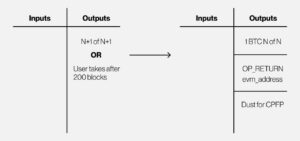
In-Peg Logic
To initiate a peg, the user locks 1 BTC in a UTXO that can only be accessed by the following parties: an N+1-of-N+1 multisig (N–1 validators, the bridge operator, and the user) or the user retrieves the funds after 200 blocks. After locking the UTXO, the user sends the transaction signature to the validators.
Once the transaction on Bitcoin is completed, the funds are transferred to a new N-of-N multisig. The user can mint their pegged BTC on Citrea by presenting an SPV proof to the smart contract. The transaction includes an EVM address used to identify the user on Citrea.
- Out-Peg Logic
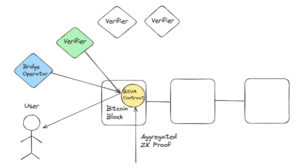
To initiate a withdrawal, the user must transfer 1 BTC to a smart contract on Citrea and provide a Bitcoin address. This address is recorded as a new leaf in the “Withdrawal Merkle Tree,” and the 1 BTC is then burned on Citrea. For simplicity, we can assume each Bitcoin address is unique, though this is not a strict requirement. Therefore, any transfer of 1 BTC to a specific Bitcoin address on the Bitcoin network results in a valid withdrawal. - Binding Source: UTXO
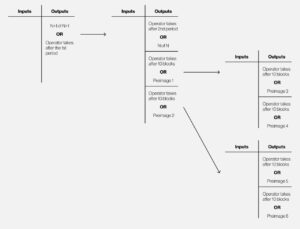
UTXO Principle
Clementine ensures that if the bridge operator tries to claim more BTC than the covered withdrawal amount, they will permanently lose access to the bridge funds.
The Connector Source UTXO is used by the operator to make claims from Clementine. To gain access to the Binding Source UTXO, the operator uses a Binding UTXO tree—essentially a UTXO tree that the operator relies on to prove the amount of BTC they can legitimately claim for the covered withdrawals.
- Two-Way Peg Scheme
Timeline

- Light Client Deadline: BitVM commitment checks block height for withdrawals.
- Submission Period: Time allocated for the operator to cover remaining withdrawals and record pre-images.
- K-deep Assumption: Ensures finality of the latest Bitcoin block. Since validators may dispute the PoW of the latest block, the operator cannot use different block hashes for private forks.
- BitVM Challenge Response Period: Period in which validators challenge the operator and enter an interactive verification game if necessary. At the end of this period, only two outcomes are possible:
The Binding Source UTXO is available for the operator to use, allowing them to claim the covered BTC during withdrawals.
b. The Binding Source UTXO is burned along with the BitVM response UTXO, revoking the operator’s access to bridge funds.
The light client checkpoint occurs every six months and continues indefinitely at the same interval.
Logic
In Clementine, once the proof—including withdrawals—is finalized on Bitcoin, the operator is responsible for covering each withdrawal. After each period, the operator reveals the log₂(n) pre-images on Bitcoin, committing the amount of bridge funds claimed from Clementine. This amount equals the total withdrawals covered since the last checkpoint of the pre-image.
EVM Equivalence
Citrea brings programmability to Bitcoin through the Ethereum Virtual Machine (EVM). Citrea’s EVM is zero-knowledge verifiable and customized for Bitcoin and BitVM. This execution environment allows users to deploy complex smart contracts beyond Bitcoin’s native scripting capabilities. Citrea scales Bitcoin by batching thousands of transactions and generating compact validity proofs. Citrea proofs are written on Bitcoin and can be optimistically verified on Bitcoin via BitVM. This model ensures on-chain data availability and verifiability.
- User Deposit
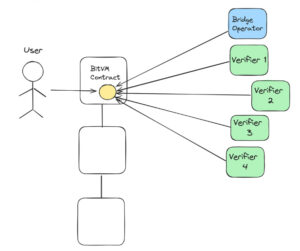
When a user sends BTC to the bridge operator, the pegging process begins. Validators (participants with the authority to challenge the bridge operator) then sign the user’s transaction. This signature is presented to the bridge operator, indicating that the validators have confirmed the BTC deposit. Once this verification step is complete, the user can mint cBTC (CitreaBTC) on Citrea by submitting the SPV (Simplified Payment Verification) of the transaction to the smart contract in exchange for BTC sent to the deposit address controlled by BitVM.
Alternatively, the user can enter Citrea via an atomic swap using Bitcoin or the Lightning Network, which is easier and cheaper than using the two-way peg deposit.
- Transaction Process
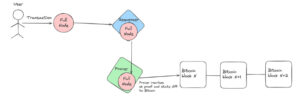
Citrea’s EVM environment enables applications such as DeFi, private transfers, or BTC-for-BTC swaps. Regardless of the user’s application, the technical process begins when the user submits a transaction to a full node. Once received, the full node forwards it to the sequencer for provisional confirmation. Anyone accessing Citrea’s transaction history or query data can set up a full Citrea node.
The sequencer is a full node that softly confirms transactions and produces blocks. These soft confirmations (soft blocks) are then propagated to every full node. The purpose of soft confirmations is to provide users with a fast transaction experience. The next step involves a specialized full node called a prover, responsible for zero-knowledge aggregation, which plays a critical role in inheriting user transaction security from Bitcoin.
Like all full nodes, the prover receives soft sequencer confirmations and stores the data. The key difference is that the prover aggregates the softly confirmed transactions into batches. It then generates a zero-knowledge proof that anyone can use to verify the validity of the batch.
The prover also creates a dataset called a state diff, representing the difference between the initial state and the latest state. The creation of the state diff explains why Citrea is efficient in using Bitcoin block space. Since Bitcoin block space is limited and costly, Citrea stores the state diff instead of full transaction data to minimize block space usage and data costs.
- User Withdrawal Process
Citrea’s Mission
Citrea aims to transform Bitcoin from being merely a store of value into a programmable financial ecosystem. This allows Bitcoin to become the hub for DeFi, NFTs, decentralized exchanges (DEXs), and next-generation financial products.
Citrea provides an innovative solution to Bitcoin’s scalability challenges using zero-knowledge technology. Its EVM compatibility enables Ethereum developers to easily build on Bitcoin, while the Clementine bridge mechanism ensures secure asset transfers.
With strong investor support, a clear technical vision, and an experienced founding team, Citrea has the potential to become the primary choice for those looking to develop applications on Bitcoin in the coming years.
You can also freely share your thoughts and comments about the topic in the comment section. Additionally, don’t forget to follow us on our Telegram, YouTube, and Twitter channels for the latest news and updates.