

 Emre Yumlu
Sapien steps in as a decentralized data foundry, aggregating human knowledge to produce verified, high-quality training data for artificial intelligence systems. In this blog post, we will explore in detail what Sapien is, how it operates, the innovations it offers, and its critical role in the world of artificial intelligence.
What is Sapien?
Sapien is a decentralized data protocol that transforms collective human knowledge into enterprise-grade AI training data. Powered by the $SAPIEN token, this open protocol enables anyone to contribute to AI development, prove the quality of their contributions, and earn rewards based on their performance.
At its core, Sapien features a financial architecture designed to ensure data quality at scale. This system eliminates reliance on centralized quality control teams by leveraging economic accountability, peer-to-peer validation, and transparent reputation mechanisms to reshape data production.
Sapien is not just a platform but also a solution that meets the need for reliable and traceable data in AI training. With over 1.8 million contributors and more than 185 million completed tasks, Sapien is utilized across various sectors, including autonomous vehicles, robotics, medical AI, education, and global development projects with institutions like the United Nations.

Challenges and Opportunities Addressed by Sapien
Challenge: Quality and Scalability Issues in AI Training
The AI industry is experiencing growth projected to exceed $1.8 trillion by 2030. However, a critical obstacle stands in the way of this expansion: sourcing the high-quality human knowledge needed to train increasingly complex AI models. Current systems face three main bottlenecks:
- Quality Verification: There is no reliable method to validate expert contributions at scale, and standards vary across providers.
- Expert Coordination: Credential verification processes are inefficient, and there is no standardized way to match experts with tasks.
- Economic Alignment: Traditional systems lose 60% of their value to intermediaries, resulting in weak incentives for quality contributions.
Opportunity: Monetizing Human Expertise Globally
These challenges create a significant opportunity as AI companies need expert knowledge more than ever, yet experts lack a standardized way to monetize their expertise. Sapien addresses these bottlenecks, providing companies with access to verified expertise at scale while creating new earning opportunities for millions of contributors. The protocol eliminates intermediaries through a decentralized system, reducing costs and enhancing data quality.
The Sapien Protocol: Revolutionizing Quality Assurance
Sapien answers a fundamental question in AI training: “Where did this data come from, and how can we trust its quality?” The protocol ensures quality and participation through four integrated systems:
- Staking Contributors lock $SAPIEN tokens before starting tasks. This stake serves as collateral tied to quality. If the task passes peer validation, the contributor earns rewards. However, low-quality work may result in partial or complete stake slashing. The stake amount and duration determine access to higher-value tasks and reward multipliers.
- Validation Completed tasks are reviewed by contributors with higher reputation scores. Accurate validators are rewarded, while those approving low-quality work face penalties. This peer-to-peer system eliminates the need for centralized quality control teams, providing scalable quality assurance.
- Reputation Each contributor builds a performance record based on accuracy, task volume, and feedback. This reputation score determines access to more complex tasks, eligibility for validator roles, and reward multipliers. Progression is entirely tied to on-chain performance.
- Incentives Contributors are rewarded with $SAPIEN tokens based on task complexity, performance, and staking duration. High performance unlocks greater rewards and access, while poor performance leads to slashing and restrictions.
These systems combine to create Proof of Quality, a trust signal derived from contributor behavior, peer validation, and economic alignment.

Gamified Contributor Experience
Sapien offers a tiered experience system where contributors progress based on performance, consistency, and reputation. This structure ensures network growth without compromising quality, allowing new users to advance toward high-value tasks.
Experience Levels:
- Trainee (Reputation: 0–199): Entry-level contributors focus on foundational skills and are reviewed by higher-ranked peers. No stake is required, but a 90% quality threshold is mandatory. Task volume is capped at 100.
- Contributor (Reputation: 200–599): Handles routine tasks and basic validation roles. Requires a minimum 250 $SAPIEN stake and 95% quality.
- Expert (Reputation: 600–799): Proven contributors with high accuracy and throughput. Eligible for premium tasks with a 5,000 $SAPIEN stake and 98% quality.
- Master (Reputation: 800–1000): The highest tier, validating complex tasks and potentially participating in protocol governance. Requires a 25,000 $SAPIEN stake and 99% accuracy.
This structure encourages learning for new users while enabling experienced contributors to enforce standards.
Proof of Quality: A Protocol-Level Solution for Trusted Data
Proof of Quality (PoQ) is the core mechanism of the Sapien protocol, replacing centralized oversight with staking, slashing, and transparent reputation to ensure quality at scale.
- Staking: Contributors lock $SAPIEN tokens as a performance guarantee. High-quality work earns rewards, while low-quality work risks stake slashing.
- Peer Validation: Tasks are reviewed by higher-reputation contributors, with critical tasks requiring multiple validators.
- Slashing and Enforcement: Low-quality or malicious behavior triggers stake slashing, with penalties varying for minor, moderate, or severe violations.
- Reward Mechanics: Rewards are based on task value, performance ranking, and staking configuration, with higher stakes and longer lockups increasing multipliers.

Governance and Risk Mitigation
Sapien is designed to operate without centralized control. Governance will transition to $SAPIEN token holders as the protocol matures, covering treasury allocation, parameter adjustments, and task approvals. All decisions are executed transparently via on-chain voting.
To ensure trust and resilience, Sapien commits to regular security audits, community metrics dashboards, and transparent treasury reports.
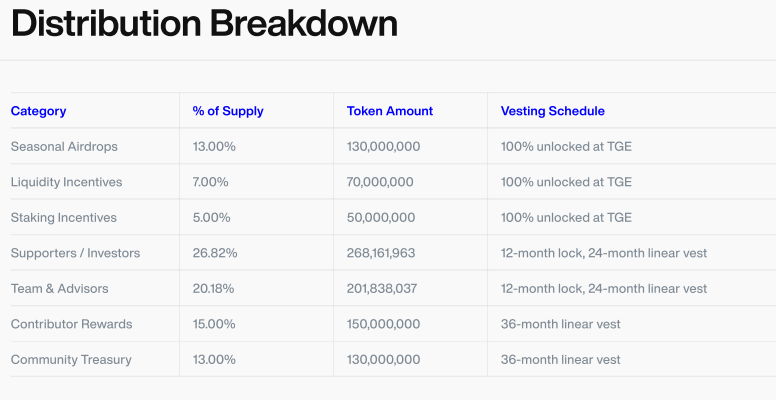
Sapien (SAPIEN) Tokenomics
- Seasonal Airdrops: 13.00%
- Liquidity Incentives: 7.00%
- Staking Incentives: 5.00%
- Supporters/Investors: 26.82%
- Team & Advisors: 20.18%
- Contributor Rewards: 15.00%
- Community Treasury: 13.00%
Sapien Investors and Backers
Sapien is supported by prominent investors including Variant, Yield Guild Games (YGG), Animoca Brands, Primitive Ventures, HF0, Ravikant Capital, Gabby Dizon, and Kevin Jiang. With $19.2 million raised, led by General Catalyst and Variant, Sapien has garnered strong institutional confidence, solidifying its leadership in AI and decentralized data.

Sapien Team and Ecosystem
Sapien is led by experts in decentralized infrastructure and AI:
- Rowan Stone (CEO): Co-creator of Coinbase’s Base (L2), former COO of Totle, and founder of Horizen Labs.
- Trevor Koverko (CSO): Founder of Polymath, Polymesh, and Tokens.com.
- Kelly Ryan (CTO): Experienced in smart contracts and gamification, previously with FastAF.
- Henry Chen (COO): Growth leader from Haller.ai, focused on high-growth strategies.

Official Links
Also, in the comment section, you can freely share your comments and opinions about the topic. Additionally, don’t forget to follow us on Telegram, YouTube and Twitter for the latest news and updates.