

 Emre Yumlu
In the world of cryptocurrency and blockchain, the integration of artificial intelligence (AI) with decentralized data infrastructures is paving the way for innovative projects. One standout in this space is OpenLedger (OPEN), an AI-blockchain infrastructure designed for training and deploying specialized AI models using community-owned datasets (Datanets). So, what exactly is OpenLedger, how does it work, and why is it gaining attention? Let’s explore!
What is OpenLedger (OPEN)?
OpenLedger is an AI-blockchain infrastructure that facilitates the training and deployment of specialized AI models using community-owned datasets called Datanets. All actions, such as dataset uploads, model training, reward credits, and governance participation, are executed on-chain. Users can create new Datanets, contribute to existing datasets, develop models, and publish them with transparent tokenized mechanisms. OpenLedger addresses the issue of data monopolization in traditional systems by ensuring data transparency, contributor rewards, and decentralization in AI development.
The platform creates an ecosystem where data contributors and model developers are transparently rewarded. Every AI output (e.g., chat, task, or API call) is traceable, revealing which model was used, which data it was trained on, and who contributed. This ensures fair compensation for contributors’ efforts and complete transparency in AI processes. The $OPEN token serves as the platform’s governance and transaction token, playing a key role in rewarding contributors and steering the ecosystem.

OpenLedger’s Key Features
OpenLedger offers a unique ecosystem through its integration of AI and blockchain. Here are the platform’s core features:
1. Data Collection with Datanets
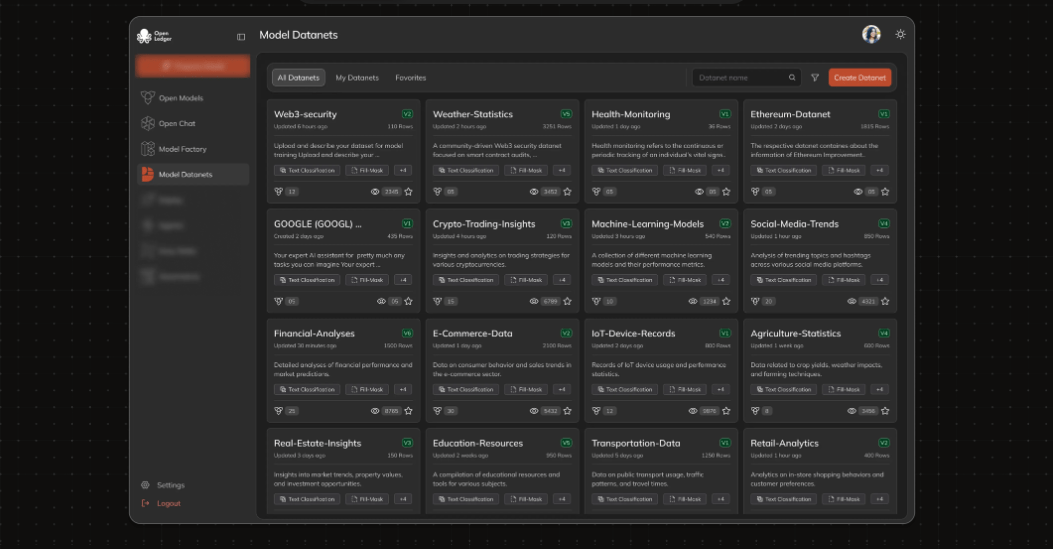
OpenLedger simplifies specialized data collection through decentralized data networks called Datanets. These networks collect, validate, and distribute high-quality datasets tailored to specific domains (e.g., healthcare, finance, social media). Users can create new Datanets or contribute to existing ones. Each contribution is verified and recorded on-chain, ensuring contributors are fairly rewarded. Datanets enable specialized AI models to be more accurate, interpretable, and efficient.
2. Easy Model Training with ModelFactory
ModelFactory is a platform within the OpenLedger ecosystem designed for fine-tuning large language models (LLMs, such as LLaMA, Mistral, DeepSeek). It operates entirely through a graphical user interface (GUI), eliminating the need for command-line tools or API integrations. Users can train models using permissioned datasets, configure hyperparameters (e.g., learning rate, batch size), and monitor the training process via real-time dashboards. Additionally, a chat interface allows direct interaction with trained models.
3. Proof of Attribution
OpenLedger’s Proof of Attribution mechanism ensures that data contributions are transparently linked to AI model outputs. This cryptographic system guarantees that every contribution is traceable, verifiable, and rewardable. Contributions are evaluated based on metrics like feature-level impact and contributor reputation. Low-quality or harmful data (e.g., biased or redundant data) is penalized, while high-quality contributions are incentivized with token-based rewards. This system enhances data transparency and reduces misinformation.
4. Governance
OpenLedger employs a hybrid on-chain governance system powered by OpenZeppelin’s modular Governor framework. $OPEN token holders can actively vote on the protocol’s direction and updates, ensuring community-driven and decentralized development.
5. Cross-Chain Bridging
OpenLedger uses the OP Stack Standard Bridge, provided by AltLayer’s Rollup-as-a-Service, to ensure secure and standardized interoperability with Ethereum. The $OPEN token is locked on L1 and minted on L2, enabling secure token transfers. This system is fully compatible with standard Ethereum tools like MetaMask, Ledger, and Hardhat.
6. Efficient Model Deployment with Open LoRA
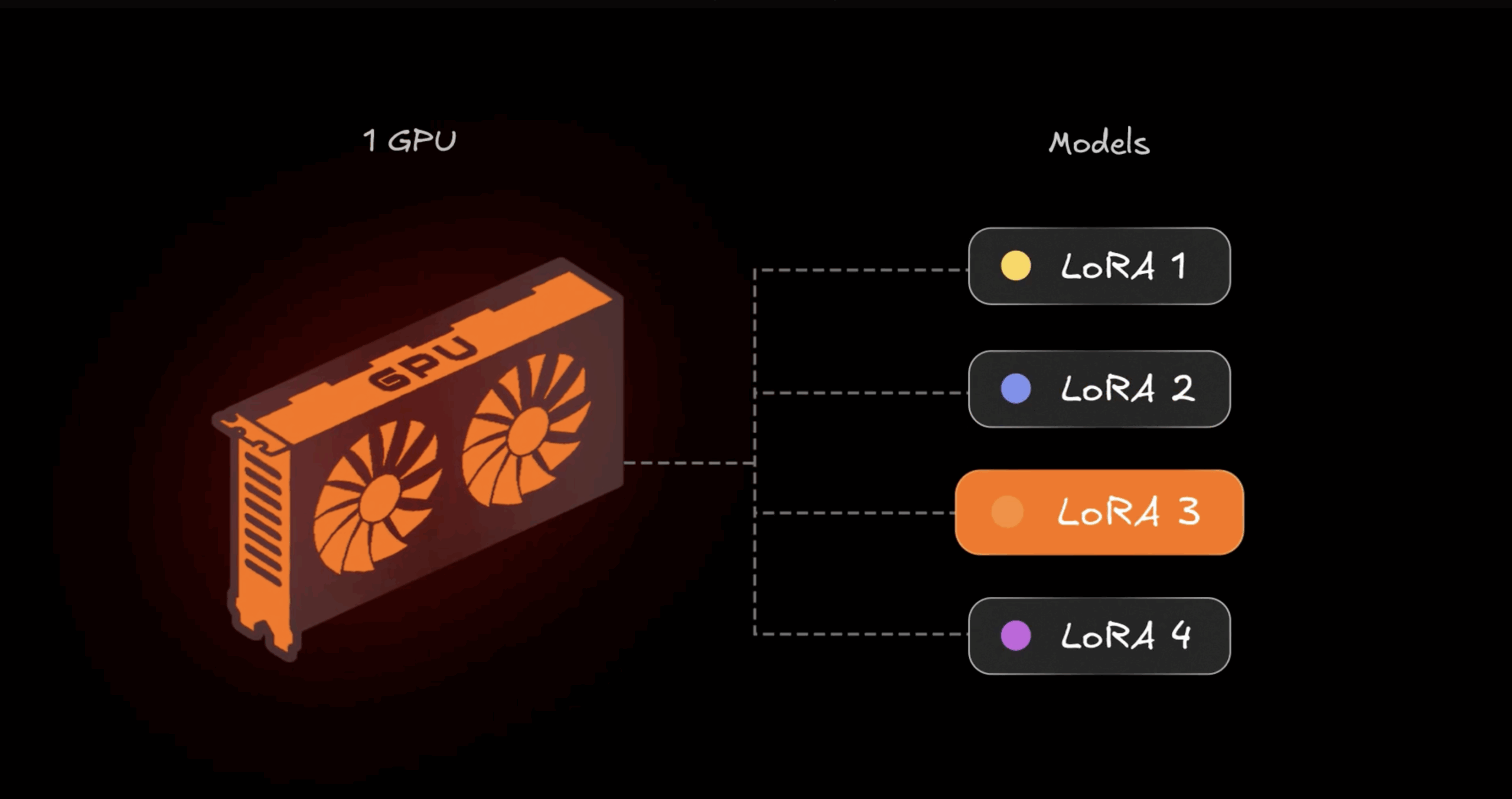
Open LoRA is a framework designed to serve thousands of fine-tuned LoRA (Low-Rank Adaptation) models on a single GPU with high efficiency and low latency. It leverages dynamic adapter loading, tensor parallelism, flash-attention, and quantization to optimize performance. This enables the simultaneous operation and cost-effective deployment of multiple models. Open LoRA is ideal for applications like personalized AI assistants and domain-specific NLP solutions.
7. API Integration
OpenLedger enables interaction with custom-trained large language models through secure API endpoints and a flexible chat interface. Developers can access and manage models using Python, JavaScript/Node.js, or curl, making it suitable for web applications, bots, and command-line environments.
How OpenLedger (OPEN) Works
OpenLedger allows users to create Datanets, contribute to existing datasets, train models, and deploy them using tokenized mechanisms. The workflow is as follows:
-
Accessing OpenLedger: Users log in via heyanon.ai using social authentication.
-
Creating and Contributing to Datanets: Users can create new Datanets or add data to existing ones. Each contribution is verified and recorded on-chain, with contributors rewarded accordingly.
-
Model Training: Through ModelFactory, users train models using their own data or Datanets. Techniques like LoRA and QLoRA enable efficient operation of multiple models on a single GPU.
-
Inference and Attribution: Every AI output tracks the model used, training data, and contributors. Contributors are rewarded based on their data’s impact.
-
Governance: $OPEN token holders vote to guide the platform’s development.
OpenLedger (OPEN) Tokenomics
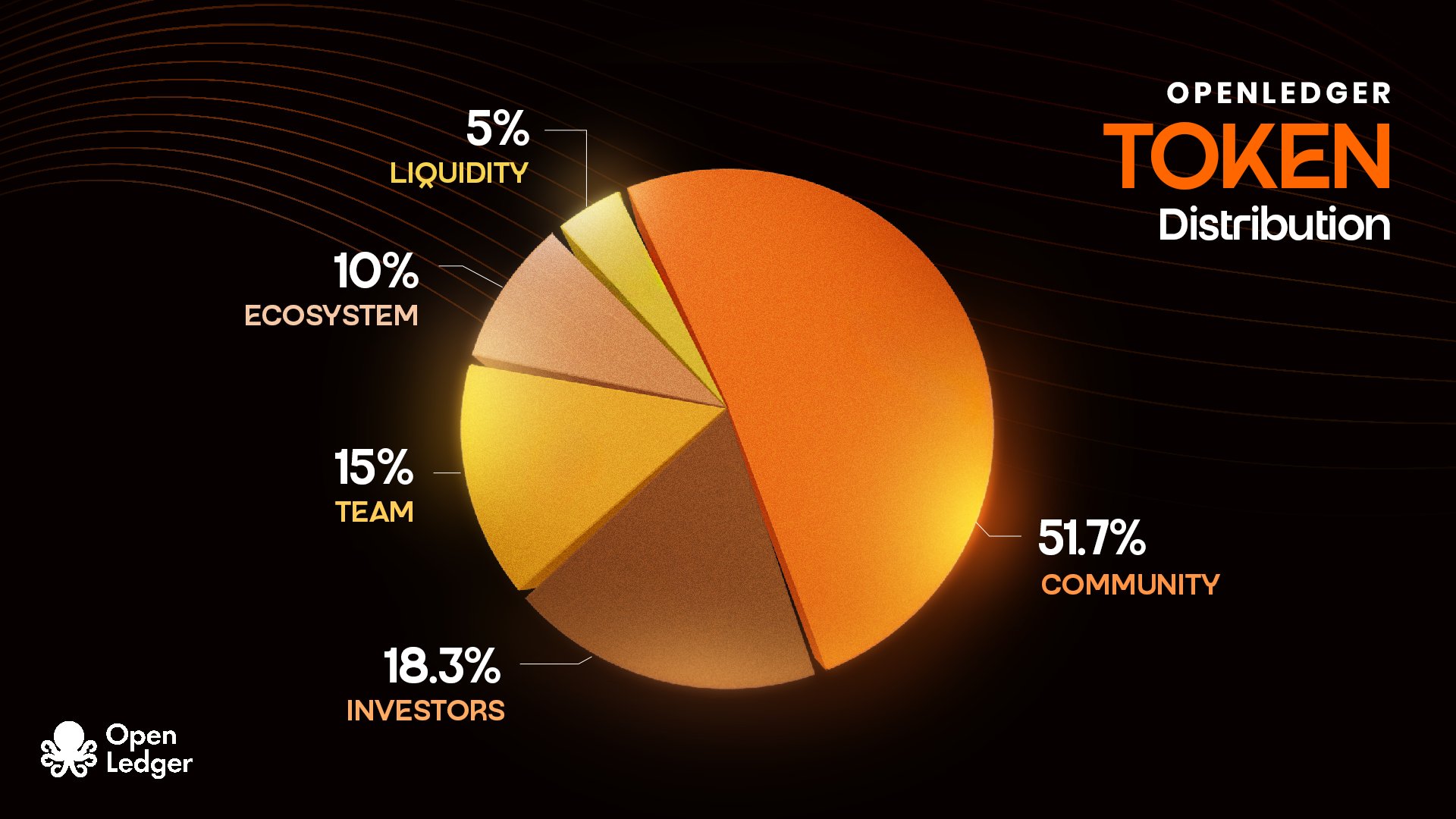
$OPEN is the native token of the OpenLedger ecosystem. Tokenomics details are as follows:
-
Distribution:
-
Community: 51.7%
-
Investors: 18.3%
-
Team: 15%
-
Ecosystem: 10%
-
Liquidity: 5%
-
-
Token Utility:
-
Governance: Voting on protocol direction and updates.
-
Transaction Fees: For on-chain operations and gas fees.
-
Rewards: Incentives for data contributors and model developers.
-
Staking: For staking AI agents.
-
OpenLedger (OPEN) Investors
OpenLedger boasts strong investor backing. In July 2024, it raised $8 million in a seed funding round led by Polychain Capital and Borderless Capital. Other notable investors include HashKey Capital, Balaji Srinivasan, Sandeep Nailwal, MH Ventures, Mask Network, Paul Taylor, TRGC, Finality Capital Partners, WAGMI Ventures, Hash3, STIX, Sebastien Borget, Scott Moore, Sreeram Kannan, Alan Curtis, chainyoda.eth, Kenny Li, and Trevor Koverko. These investors reflect confidence in OpenLedger’s vision to lead in AI and blockchain integration.

OpenLedger (OPEN) Team
OpenLedger was founded in 2024 by Ramkumar Subramanian and Elangovan Kamesh. Ramkumar Subramanian, an expert in decentralized systems, leads the team, while Elangovan Kamesh strengthens the project’s technical foundation with his expertise in AI infrastructure. The team comprises experienced professionals who have worked with brands like Sony, Walmart, Polygon, and Hedera.

Official Links
You can share your opinions in the comments about the topic. Also, follow us on Telegram, Twitter, and YouTube for more content like this.