

 Emre Yumlu
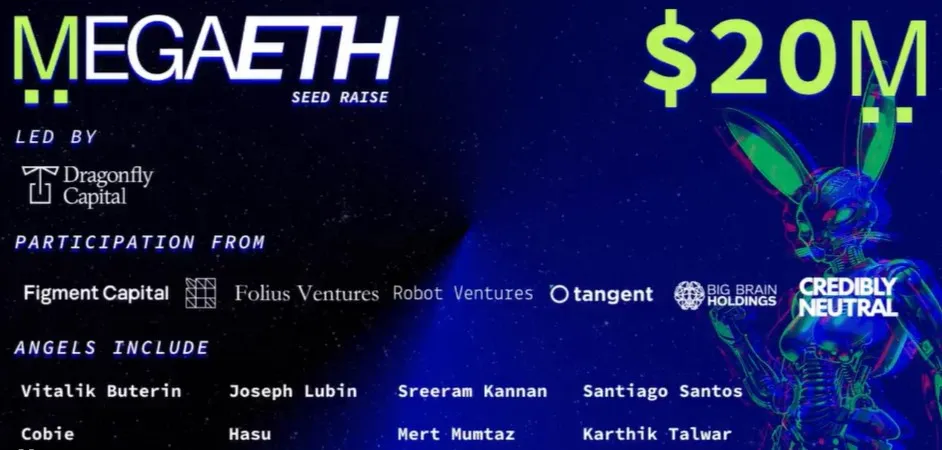
MegaETH (MEGA) is an innovative Layer-2 (L2) blockchain project aimed at transforming the Ethereum network into a real-time platform. It offers sub-millisecond transaction latency and over 100,000 transactions per second (TPS), solving Ethereum’s existing scalability and speed issues. Developed using C++ and Rust, MegaETH is fully compatible with the Ethereum Virtual Machine (EVM), meaning existing Ethereum smart contracts can be used without rewriting. The project is backed by a $20 million investment from leading names and firms such as Dragonfly, Vitalik Buterin, Santiago Roel Santos, Robot Ventures, Big Brain Holdings, Folius Ventures, Figment Capital, Credibly Neutral, Tangent, Mert Mumtaz, Sreeram Kannan, Kartik Talwar, Hasu, Cobie, and Joseph Lubin. MegaETH establishes a symbiotic relationship with the Ethereum ecosystem, delivering a Web2-speed experience for Web3 applications. In this article, we will examine in detail what MegaETH is, how it works, its use cases, advantages, risks, tokenomics, team, and investors.
What is MegaETH (MEGA)?
MegaETH is designed as a Layer-2 solution to enhance Ethereum’s performance. While traditional L2 solutions (such as Arbitrum, Optimism, zkSync) provide scalability through batching, MegaETH achieves sub-millisecond latency with parallel transaction execution and asynchronous processing. This creates a revolution, especially in high-frequency applications like DeFi, NFT mints, and gaming.
MegaETH allows developers to easily migrate existing Solidity or Vyper code thanks to EVM compatibility. The project employs innovative technologies such as a hyper-optimized EVM execution engine, an EVM bytecode-to-native code compiler, efficient concurrency control protocols for parallel EVM, low-latency transaction streaming, memory and input-output (IO) efficient state trie design, high-throughput transaction broadcasting protocol, and advanced databases for storing blockchain state and history data. MegaETH aims to deliver a Web2-speed user experience while preserving Ethereum’s decentralization and security principles.
Purpose of MegaETH
Ethereum is the foundational infrastructure of Web3, powering everything from DeFi protocols to NFTs, gaming, and decentralized applications (dApps). However, the network’s speed and scalability issues become particularly evident during high-traffic periods (NFT mints, meme coin frenzies). Existing L2 solutions provide scalability through batch processing, but 5–30 second delays and high gas fees negatively impact user experience.
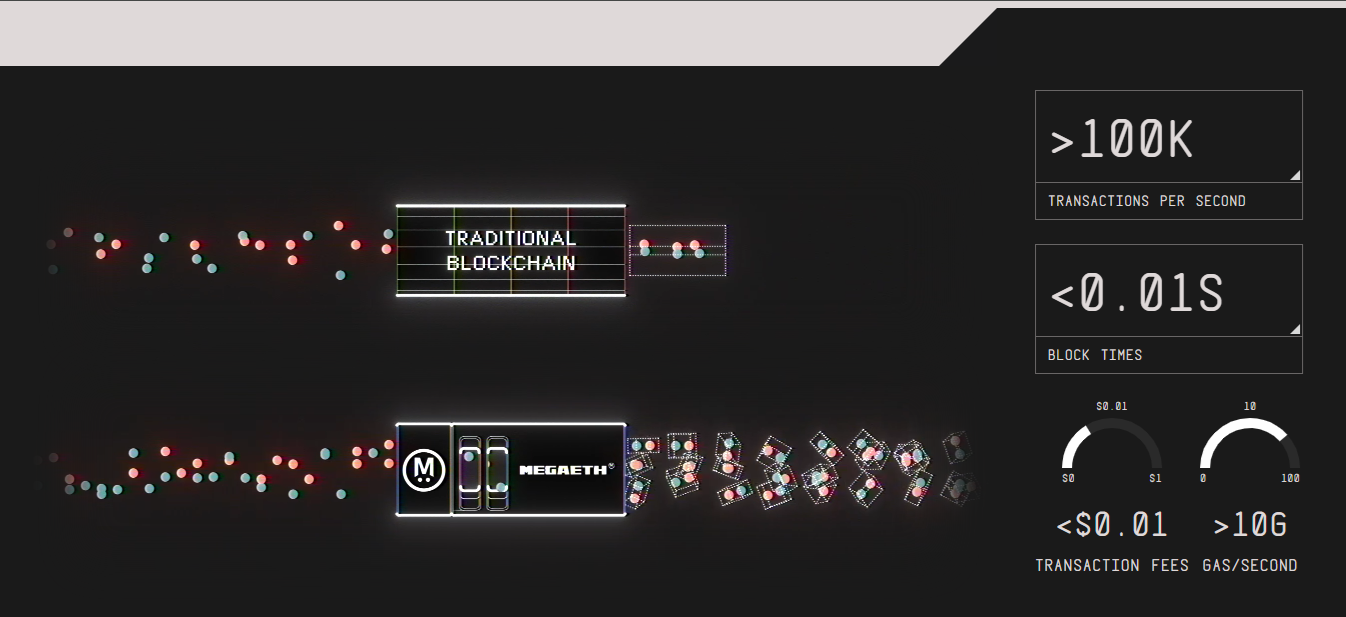
MegaETH addresses these issues by offering sub-millisecond transaction finality and 100,000+ TPS, delivering a real-time Ethereum experience. The project’s goal is to strengthen Ethereum’s existing ecosystem by providing a fast, secure, and low-cost infrastructure across a wide range of applications, from financial transactions to gaming. MegaETH aims to enable Web3 to compete with Web2 in terms of speed while preserving Ethereum’s decentralized structure.
How Does MegaETH Work?
MegaETH operates by redesigning traditional blockchain transaction processing methods. It uses a parallel and modular architecture, processing transactions with three different types of nodes:
-
Sequencer Nodes: Order transactions and batch them, ensuring the network operates smoothly.
-
Executor Nodes: Execute transactions in parallel, distributing the load across multiple cores and machines.
-
Verifier Nodes: Verify execution integrity and generate cryptographic proofs for final settlement on the Ethereum mainnet.
The asynchronous consensus layer does not halt execution during block validation, eliminating traditional L2 bottlenecks. MegaETH is written in C++ and Rust, enabling low latency and high efficiency. EVM compatibility allows existing Ethereum smart contracts to be used directly.
Adaptive node roles ensure the system operates in balance; sequencers schedule transactions, executors run them in parallel, and verifiers validate the results. This structure delivers sub-second finality even under high network load.
Technical Features:
-
Speed and Scalability: Sub-millisecond latency, 100,000+ TPS.
-
Parallel Execution: Multiple smart contracts run simultaneously with concurrency control protocols.
-
Asynchronous Consensus: Block validation does not interrupt transaction execution.
-
EVM Compatibility: Existing Ethereum code is portable.
-
State Trie Design: Memory and IO efficient, high-performance data storage.
-
Databases: Optimized for storing blockchain state and history.

Transaction Process:
-
The user initiates a transaction on the MegaETH network (e.g., DeFi trade, NFT mint).
-
Sequencer nodes order and batch the transactions.
-
Executor nodes execute the transactions in parallel.
-
Verifier nodes verify correctness and finalize on Ethereum.
MegaETH Use Cases
MegaETH is ideal for high-frequency and low-latency applications:
-
DeFi: Orderbook-based perpetuals, RFQ routers, arbitrage, and MEV-protected transactions; millisecond speeds reduce slippage.
-
NFT and Media: Real-time mints, auctions, and royalty streams; delay-free user experience.
-
Gaming (GameFi): On-chain state updates for combat, trading, and leaderboards; uninterrupted gameplay.
-
Agentic/AI dApps: Fast, small on-chain actions for AI-based applications.
Usage Steps:
-
Connect a wallet like MetaMask to the MegaETH network.
-
Bridge assets from Ethereum mainnet to MegaETH L2.
-
Develop dApps with EVM-compatible Solidity/Vyper code.
-
Test fast transactions on testnet or mainnet.
-
Use integrations like AMMs, lending protocols, or gaming SDKs.
Advantages of MegaETH
-
Real-Time Speed: Sub-millisecond transaction finality, Web2-speed experience.
-
Scalability: Over 100,000 TPS, stable under high load.
-
EVM Compatibility: Seamless integration with existing Ethereum infrastructure.
-
Security: Preserves Ethereum’s decentralized structure, enhanced with parallel execution.
-
Developer-Friendly: Code portability, compatible with MetaMask and Hardhat/Foundry tools.
-
User Experience: Low gas fees, fast transactions.
Risks of MegaETH
-
Development Stage: Still in testnet; unknown risks on mainnet.
-
Integration Challenges: Transition from Ethereum to L2 may create a learning curve for users and developers.
-
Regulatory Uncertainty: Regulations for Layer-2 projects may pose risks.
-
Dependency: Reliance on Ethereum mainnet security is a potential limitation.
-
Competition: Rivalry with L2s like Arbitrum and Optimism may affect market share.
MegaETH Tokenomics
MegaETH’s $MEGA token is the network’s native utility and governance token. Tokenomics details are limited, but available information is as follows:
-
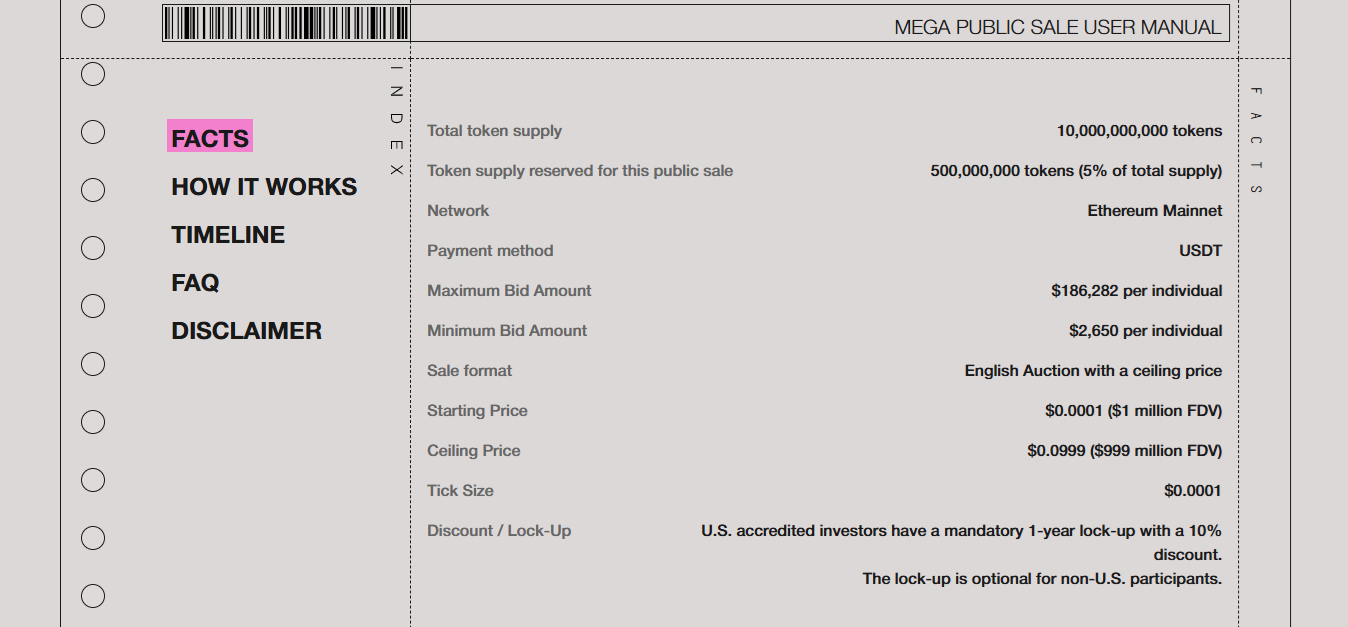
Total Supply: 10,000,000,000 $MEGA.
-
Public Sale: 500,000,000 tokens (5%).
-
Network: Ethereum Mainnet.
-
Payment Method: USDT.
-
Sale Format: English auction with a ceiling price.
-
Starting Price: $0.0001 (1 million FDV).
-
Ceiling Price: $0.0999 (999 million FDV).
-
Tick Size: $0.0001.
-
Discount/Lock-Up: 10% discount and 1-year mandatory lock-up for U.S. accredited investors; lock-up optional for others.
-
Individual Participation: Minimum $2,650, maximum $186,282.
The token can be used for network operations and governance; full tokenomics details are yet to be announced.
Technical Infrastructure of MegaETH
MegaETH’s innovative architecture is built on parallel transaction processing and asynchronous consensus:
-
Hyper-Optimized EVM: Execution engine optimized for large-RAM sequencer nodes.
-
EVM Bytecode Compiler: Converts bytecode to native code, boosting performance.
-
Concurrency Protocols: Efficient control for parallel EVM, preventing transaction conflicts.
-
State Trie Design: Memory and IO efficient, fast data access.
-
High-Throughput Broadcasting: Low-latency protocol for transaction propagation.
-
Databases: Optimized storage for blockchain state and history.
These features enable MegaETH to operate at Web2 speeds, providing an ideal infrastructure for DeFi, NFTs, and gaming.
Future of MegaETH
MegaETH is in the testnet phase and will solve Web3’s speed issues with its mainnet launch. EVM compatibility facilitates integration with the existing Ethereum ecosystem; integrations with wallets (MetaMask), bridges, and DeFi protocols (AMMs, lending) are planned. The project will measure success with TVL (total value locked) and latency-under-load metrics. MegaETH is taking a critical step for Web3 to compete with Web2.
MegaETH Investors
MegaETH has raised $20 million; investors include leading industry figures:
-
Tier 1: Dragonfly, Santiago Roel Santos, Vitalik Buterin.
-
Tier 2: Robot Ventures.
-
Tier 3: Big Brain Holdings, Folius Ventures, Figment Capital.
-
Tier 4: Credibly Neutral, Tangent.
-
Individual Investors: Mert Mumtaz, Sreeram Kannan, Kartik Talwar, Hasu, Cobie, Joseph Lubin.
These investors trust MegaETH’s technical vision and potential in Web3.
MegaETH Team
MegaETH’s founding team specializes in blockchain and high-performance systems:
-
Yilong Li (Co-Founder): Shapes the project’s vision, provides strategic leadership.
-
Lei Yang (Co-Founder and CTO): Mantech technical infrastructure, C++ and Rust expert.
-
Shuyao Kong (Co-Founder): Product development and user experience leader.
-
Namik Muduroglu (CSO): Sales and strategic partnerships.
-
Laura Shi (COO): Operational management and process optimization.
-
Amir Almaimani (Head of Ecosystem): Ecosystem growth and integrations.
-
heisenbruh (Founding Team Member): Technical development and infrastructure.
The team has a strong technical vision to solve Web3’s speed issues.

Official Links
You can also freely share your thoughts and comments about the topic in the comment section. Additionally, don’t forget to follow us on our Telegram, YouTube, and Twitter channels for the latest news and updates.