

 Yeliz Akmaca
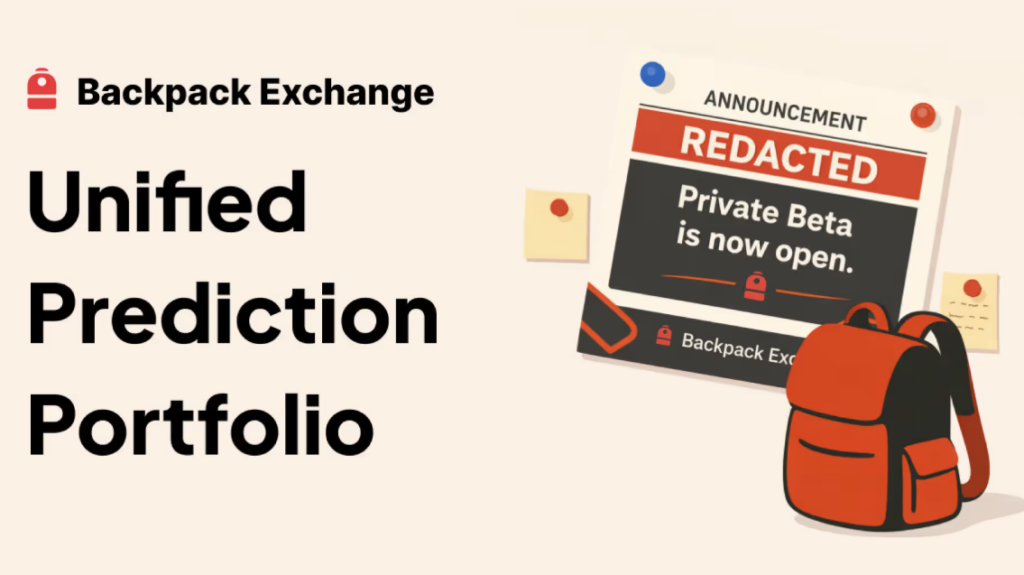
Backpack Exchange has quietly launched a closed beta of its cross-margined prediction markets, signaling a structural shift in how traders can deploy capital across bets and trading products. The feature, called Unified Prediction Portfolio, arrives as prediction markets gain visibility — but also as their inefficiencies become harder to ignore.
The core issue has never been prediction accuracy alone. In most prediction markets, capital gets locked until an event resolves, sitting idle while opportunities elsewhere disappear. Even when traders have an edge, the opportunity cost of frozen capital often erodes returns. Backpack’s new model is explicitly designed to target that inefficiency.
Capital No Longer Sits Idle
Prediction markets have historically forced traders into a passive posture. Once a position is opened, capital is trapped. Backpack’s Unified Prediction Portfolio breaks that constraint by allowing crypto capital to remain productive across multiple products at the same time.
Through cross-margining and cross-collateralization, a single balance can support prediction positions alongside spot trades, margin trading, perpetual futures, and crypto lending. Capital no longer waits for outcomes — it moves.
One Margin Account, Built Natively
A critical distinction Backpack emphasizes is that this system is not a wrapper built on top of Kalshi, Polymarket, or any external prediction platform. Prediction markets are fully native to Backpack’s exchange infrastructure, priced and managed within its own risk engine.
In practice, this allows a workflow rarely possible in prediction markets. A trader can quote on a price prediction, get filled, and immediately hedge that exposure using perpetual futures — all within the same margin account. Predictions stop being isolated bets and start behaving like tradeable risk components.
Prediction Markets Turn Active, Not Passive
By embedding predictions into a unified trading stack, Backpack challenges the traditional wait-and-see model. Traders are no longer forced to hold static positions until resolution. Risk can be adjusted dynamically as market conditions change.
This structure effectively pulls prediction markets closer to derivatives trading, where exposure is continuously managed rather than passively held. That shift alone could reshape how professional traders engage with this market segment.
Click here to register for the Backpack exchange at a discounted rate.
Invite-Only Beta With Risk Front and Center
Access to Unified Prediction Portfolio is currently limited to an invite-only beta, focused on Backpack’s most active traders. The company says this phase is intended to observe real-world behavior and refine the system before broader release.
That caution is notable. Cross-margin flexibility also concentrates risk. Losses in one product can quickly spill over into others during periods of volatility, amplifying drawdowns faster than traders may anticipate. Testing the risk engine under controlled conditions appears less like a formality and more like a necessity.
A Post-FTX EU Expansion Strategy
Backpack’s move into prediction markets follows a transformative year for the exchange. In January 2025, Backpack acquired FTX EU, gaining access to a MiFID II–regulated European framework. By April, the company initiated asset recovery for users whose funds had remained frozen since the 2022 FTX collapse.
Against that backdrop, prediction markets look less like an experiment and more like a calculated extension of an increasingly integrated trading platform.
A Crowded Market, A Different Approach
The broader prediction market sector continues to expand rapidly. In December 2025, Kalshi reported $6.26 billion in trading volume, up from $5.81 billion the previous month. Polymarket reached $2.28 billion, compared to $1.87 billion in November.
As prediction markets move closer to mainstream use cases, competition is shifting away from novelty toward structure and capital efficiency. Backpack’s unified, cross-margined model introduces a different risk–reward equation — one that offers flexibility, but demands discipline.
Whether that flexibility ultimately becomes a durable advantage will depend less on the technology itself and more on how traders adapt to the freedom it creates.
You can also freely share your thoughts and comments about the topic in the comment section. Additionally, don’t forget to follow us on our Telegram, YouTube, and Twitter channels for the latest news and updates.