

 Haciyev Reşit
The stablecoin market is showing renewed growth, with Tether’s USDT once again at the center of this momentum. With its increasing market cap and broad usage, USDT continues to serve as a key liquidity tool for both retail investors and professional market participants. On-chain data highlights that stablecoins are not only used as a hedge against price volatility but also remain among the most important indicators for understanding capital flows, risk appetite, and investor behavior in the crypto market.
Why Stablecoins Are a Critical Indicator
Stablecoins act as a safe haven during periods of high volatility and serve as a fundamental medium of exchange across spot markets, derivatives, and DeFi protocols. Therefore, stablecoin movements intersect with whale positions, institutional capital inflows, and retail investor behavior. According to DeFiLlama, the total stablecoin market capitalization has reached $311 billion, and industry forecasts suggest this could grow to $1.6 trillion by 2030.
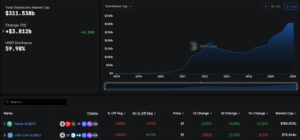
- USDT (Tether): ~$186 billion market cap
- USDC (Circle): ~$76 billion market cap
USDT remains the preferred stablecoin for global retail investors, spot market participants, and DeFi users. However, USDT transaction activity on Ethereum and Tron networks is showing a noticeable decline, indicating a temporary slowdown in retail participation and DeFi activity. Conversely, USDC has emerged as an important institutional indicator due to regulatory compliance and adoption by corporate financial institutions.
Institutions Step In, Retail Pulls Back
On-chain data shows that retail trading volumes are decreasing, while institutional activity demonstrates steady, cautious growth. Rising USDC volumes suggest that institutions are adopting more controlled strategies rather than high-risk speculative positions. This trend supports the idea that the market is entering an “early accumulation” phase.
Currently, the total stablecoin supply held on exchanges is $87.5 billion, with $63.4 billion on centralized exchanges (CEXs) and $24.1 billion on decentralized exchanges (DEXs). Increasing stablecoin balances on CEXs indicate that investors are positioning capital ahead of potential market moves, while DEX activity suggests that speculative appetite could rebound.
Macro Factors Shape Stablecoin Demand
Federal Reserve policies, global trade tensions, and geopolitical uncertainties directly impact stablecoin demand. The dominance of North America and Europe in stablecoin trading means that macro decisions in these regions can quickly affect the crypto market.
Expert Assessment:
“Stablecoin movements provide early signals for the next trend in crypto. The divergence between USDT and USDC clearly shows the separation between retail and institutional investor behavior.”
As the stablecoin market enters a growth phase again, USDT dominates retail activity, while USDC leads in the institutional segment. Macroeconomic developments, regional capital flows, and exchange balances will be key factors shaping stablecoin demand in the coming period.
Also, you can freely share your thoughts and comments about the topic in the comment section. Additionally, please follow us on our Telegram, YouTube and Twitter channels for the latest news and updates.