

 Haciyev Reşit
The trade tension between the United States and China continues to impact not only traditional financial markets like stocks, commodities, and forex but also the cryptocurrency market, albeit indirectly yet significantly. While China’s response to President Donald Trump’s aggressive tariff policies appears calm and controlled at first glance, it creates a chain reaction affecting Bitcoin through global liquidity flows and dollar-based capital movements. Experts note that this influence shapes crypto markets more through macroeconomic balances and monetary policy channels than short-term news.
Trump’s Tariffs and China’s Strategic Response
With Trump’s return to office, the U.S. sharply increased tariffs on goods imported from China. By January 2026, the average U.S. tariff on Chinese imports reached 29.3%. While theoretically aimed at weakening China’s export power and bringing production back to the U.S., in practice, Beijing has taken a more flexible, long-term strategic approach.
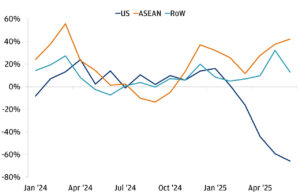
China has managed to preserve its global market share by shifting exports toward ASEAN countries and other regions, reducing its dependency on the U.S. market. According to JPMorgan, China’s actual exports are projected to grow about 8% in 2025, with its global export share rising to 15%. In contrast, exports to the U.S. have fallen below 10% of total exports, reflecting this structural shift.
A key factor behind China’s resilience is its strict and controlled management of the yuan. JPMorgan highlights that China maintains a low-volatility currency regime, keeping the yuan largely pegged to the U.S. dollar. Although the yuan has strengthened about 4% since its 2023 lows, this appreciation is carefully managed within a controlled band rather than left to free-market forces.
Chinese policymakers deliberately prevent rapid and sharp yuan appreciation to preserve export competitiveness and limit deflationary pressures on the economy. This strategic approach indirectly influences global dollar liquidity, shaping financial market balances and creating an important mechanism affecting Bitcoin’s macro environment.
How This Dynamic Affects Bitcoin
Macro-sensitive assets like Bitcoin are highly responsive to changes in dollar liquidity. During periods of increased uncertainty and risk aversion, dollar liquidity tightens, putting pressure on BTC. Conversely, easing tensions and expanding liquidity provide a supportive environment for Bitcoin. JPMorgan notes that China’s currency policy accelerates this process. During heightened U.S.-China trade tensions, stronger dollar-based cash flows often result in volatile but directional price movements in Bitcoin. For instance, BTC showed a similar reaction during the March–April period of the previous year when trade tensions escalated.
Aligning with Arthur Hayes’ Thesis
This scenario aligns with the long-held views of BitMEX co-founder Arthur Hayes. According to Hayes, tariffs and trade negotiations are largely political displays, while the true market drivers are currency policies, capital flows, and global liquidity management. In short, China’s response to Trump’s tariffs goes beyond export numbers. Managed yuan policies and global liquidity cycles quietly but effectively shape the macro environment in which Bitcoin trades. For crypto markets, this underscores the importance of monitoring liquidity and monetary policy dynamics over short-term headlines.
You can also freely share your thoughts and comments about the topic in the comment section. Additionally, don’t forget to follow us on our Telegram, YouTube and Twitter channels for the latest news and updates.