

 Haciyev Reşit
HyperLend is a decentralized finance (DeFi) lending protocol built on Hyperliquid EVM, allowing users to lend their crypto assets or borrow against collateral. Instead of the classic “peer-to-peer matching” model, it operates through liquidity pools. Users provide liquidity to these pools and earn interest or borrow against collateral without negotiating individually with lenders. HyperLend’s non-custodial structure is crucial: assets are not held in a company account, and transactions are executed via smart contracts. Within the Hyperliquid ecosystem, HyperLend often functions as the “banking infrastructure”: capital is pooled in the protocol, users borrow this capital, interest rates adjust based on supply and demand, and risk management is automated on-chain.

How HyperLend Works
HyperLend operates through several core components:
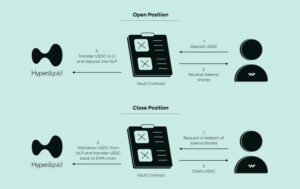
- Providing Liquidity (Supply / Lend): Users deposit assets (e.g., USDC or ecosystem tokens) into protocol pools, expanding liquidity available for borrowers. Lenders earn interest based on pool utilization.
- Borrowing: Users deposit collateral and borrow against it. Collateral requirements depend on the risk of the borrowed asset, LTV parameters, and market conditions. Borrowed funds accrue interest over time.
- Interest Rate Dynamics: Rates are variable, determined by pool utilization (“Linear Interest Calculator”). High utilization increases borrowing costs, incentivizing liquidity provision.
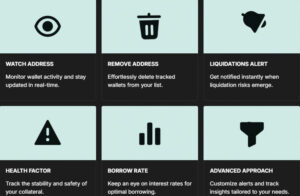
- Liquidation: If collateral value drops and the user’s “health factor” approaches a critical level, the protocol liquidates positions to prevent bad debt. Rules are encoded in smart contracts and executed on-chain.
This automated, transparent system differs from traditional banking, as users do not need central approval to borrow if collateral is sufficient.

Why Hyperliquid EVM Matters
HyperLend emphasizes the performance of Hyperliquid: high throughput and low latency are crucial for DeFi lending, where speed affects system health.
- Fast collateral updates: Volatile asset prices require real-time LTV and position calculations.
- Timely liquidations: Slow chains increase bad debt risk; low-latency infrastructure ensures liquidation mechanisms execute instantly.
- User experience: Fast block confirmations improve borrowing, collateral management, and repayment during high volatility.
HyperLend also benefits from Hyperliquid’s HyperBFT consensus, on-chain order book architecture, and native spot market support, providing a stable foundation for sensitive financial layers. Builder applications on Hyperliquid can directly integrate with HyperLend’s liquidity and lending layers, enabling faster scaling and efficient capital allocation. HyperLend aims to be a core liquidity infrastructure in Hyperliquid’s expanding on-chain financial ecosystem.

HPL Token: Purpose and Utility
HPL is central to HyperLend, designed not just as a value transfer token but also as a mechanism driving protocol governance and incentives:
- Governance: HPL holders or stakers can participate in protocol decisions, including risk parameters, LTV ratios, liquidation thresholds, and new asset markets.
- Incentives & Rewards: HPL rewards liquidity providers, active users, and new participants, complementing interest income to attract capital.
This dual structure ensures HPL is tied to protocol usage and governance power rather than speculative price swings. The more users participate and provide liquidity, the stronger the token’s role within HyperLend.
Product Layers: Beyond Simple Lending
HyperLend includes modules to cater to different risk appetites:
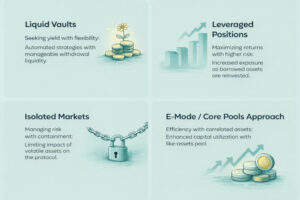
- Liquid Vaults: For users seeking yield with flexibility. Automated strategies optimize asset efficiency while minimizing withdrawal friction.
- Leveraged Positions: Borrowed assets are reinvested to increase exposure, offering higher potential returns but greater liquidation risk.
- Isolated Markets: Limits risk from a single volatile asset affecting the entire pool, allowing more controlled risk management.
- E-Mode / Core Pools: Enables higher capital efficiency with correlated assets like stablecoins; requires careful risk assumptions.
HPL Tokenomics and Distribution
HPL tokens are allocated to support long-term ecosystem growth:
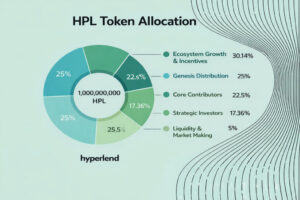
- Ecosystem growth & incentives: 30.14%
- Genesis distribution: 25%
- Core contributors: 22.5%
- Strategic investors: 17.36%
- Liquidity & market support: 5%
Token launch is planned via a Token Generation Event (TGE), with staking and locking mechanisms shortly afterward to ensure controlled release. Early users are rewarded via a points-based system, incentivizing participation across both HyperLend and Hyperliquid ecosystems.
Risk Management
HyperLend uses standard DeFi metrics:
- LTV (Loan-to-Value): Maximum borrowable amount against collateral. Higher LTV increases risk of liquidation in volatile markets.
- Health Factor: Indicates distance from liquidation; users can adjust collateral or reduce debt to improve it.
- Dynamic Interest Model: Rates change automatically based on pool utilization, balancing supply and demand.
- Real-Time Monitoring: On-chain and off-chain liquidity, volatility, and trading data inform risk updates.
- Asset Listing Discipline: Only high-liquidity and low-manipulation assets are accepted as collateral.
Dynamic parameter updates help maintain stability across both bull and bear markets.
Security
Security is fundamental for DeFi:
- Audits from independent firms
- Bug bounty program for global developer participation
- Continuous monitoring and public reporting ensure transparency
While audits reduce risks, they cannot eliminate them completely, especially under high-volume usage. Security is a continuous process, not a one-time check.

Strategic Partnerships
HyperLend has partnered with projects to strengthen DeFi infrastructure and integrate within Hyperliquid:
- Thunderhead: Ecosystem integration
- Theo: Liquidity and financial infrastructure
- Pyth Network: On-chain price oracles
- RedStone: Real-time data feeds for reliable risk management
- Resolv: DeFi and risk integration
- Swell: Liquidity and staking ecosystem support
These partnerships position HyperLend as a core financial infrastructure rather than a standalone protocol.

Who Uses HyperLend?
- Passive yield seekers: Deposit stablecoins or major assets to earn interest.
- Liquidity borrowers: Borrow against collateral without selling assets.
- Advanced strategists: Use loops/cycles for capital efficiency.
- Traders: Quickly leverage capital alongside derivative/spot markets.
In summary, HyperLend (HPL) is a DeFi lending protocol on Hyperliquid EVM that makes lending and borrowing transparent and automated via pool-based markets. The HPL token powers governance and incentives, while modules like liquid vaults, leveraged positions, and isolated markets position HyperLend as a complete on-chain lending layer.
Official Links:
- Website
- X (Twitter)
- Whitepaper