

 Yeliz Akmaca
U.S. President Donald Trump has urged Congress to move quickly on comprehensive cryptocurrency market legislation, calling for the bill to be passed “ASAP.” Trump also sharply criticized the banking sector, accusing major banks of deliberately slowing progress on both the GENIUS Act and the CLARITY Act. At the center of the dispute is whether crypto platforms should be allowed to offer yield or reward programs for users holding stablecoins.
In recent weeks, the debate around crypto regulation in Washington has intensified. What appears to be a technical regulatory issue is increasingly becoming a broader struggle between traditional finance and the crypto industry over who will shape the future structure of digital finance.
Trump: “Americans Should Earn More on Their Money”
In a Truth Social post, Trump said the United States needs to finalize its crypto market structure legislation quickly. His message directly targeted banks, which he accused of trying to block new opportunities for Americans to earn returns on digital assets.
According to Trump, while banks are reporting record profits, they are attempting to prevent retail users from earning yield through stablecoins.
Trump wrote:
“The U.S. needs to get Market Structure done, ASAP. Americans should earn more money on their money. The Banks are hitting record profits, and we are not going to allow them to undermine our powerful Crypto Agenda.”
Political analysts in Washington interpreted the statement as a signal that the administration intends to push forward with crypto-friendly policy despite resistance from traditional financial institutions.
The Core Dispute: Stablecoin Yield
The biggest obstacle preventing the legislation from advancing in the Senate centers on a specific issue:
whether crypto exchanges should be allowed to offer yield-like rewards to users holding stablecoins.
Banks strongly oppose the model, arguing that stablecoin yield programs could directly compete with traditional bank deposits and savings accounts. Financial institutions are therefore pushing for stricter limitations within the legislation.
Crypto companies, however, argue the opposite. They claim that allowing users to earn yield on stablecoins is a natural extension of decentralized financial infrastructure.
Negotiations between the banking and crypto industries have been facilitated by White House crypto adviser Patrick Witt. However, the talks have already passed the administration’s informal March 1 deadline for reaching an agreement.
CLARITY Act Faces Uncertain Senate Support
Despite Trump’s call for urgency, the legislative path remains uncertain. The CLARITY Act, which aims to establish a regulatory framework for digital asset markets, still faces an unclear vote count in the Senate.
Without a compromise on stablecoin yield programs, the bill may struggle to secure the necessary support to pass.
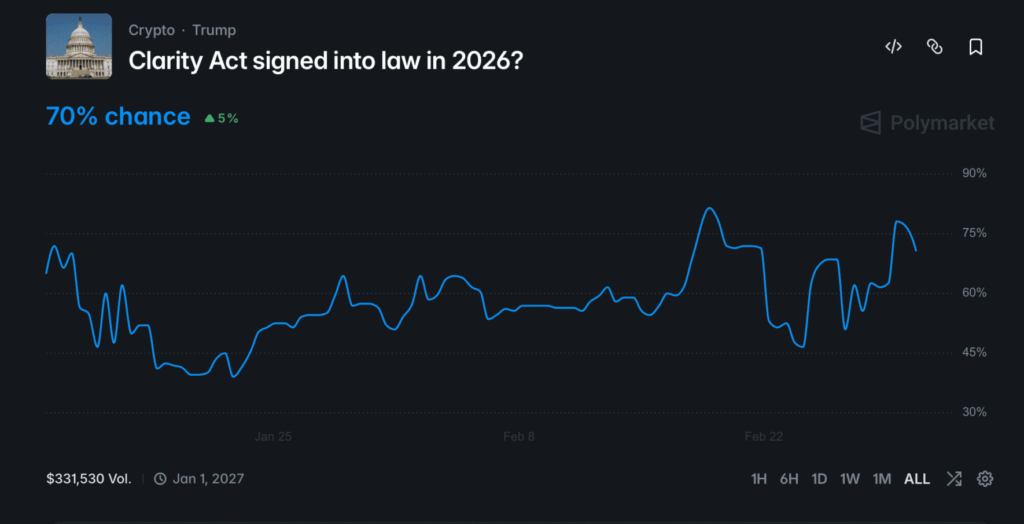
Still, market expectations have recently improved. According to prediction market platform Polymarket, the probability that the legislation will pass in 2026 climbed to around 70% following Trump’s comments.
Divisions Inside the Crypto Industry
Interestingly, disagreements are not limited to banks and regulators. The crypto industry itself is also divided over the proposed legislation.
Cardano founder Charles Hoskinson recently argued that the CLARITY Act should not move forward in its current form. Hoskinson suggested that several provisions in the bill could limit innovation within the crypto ecosystem.
Meanwhile, leaders from Ripple have taken a more pragmatic stance. Ripple’s CTO said that an imperfect regulatory framework is still better than having no regulatory clarity at all.
The disagreement highlights how the crypto sector does not always present a unified front when lobbying policymakers in Washington.
Could Banks Ultimately Lose the Stablecoin Fight?
Policy analyst Jaret Seiberg from TD Cowen believes banks could ultimately lose the battle over stablecoin yields. However, he warned that the dispute could drag on long enough to threaten the broader crypto market structure legislation itself.
In other words, a single unresolved issue—stablecoin yield programs—could delay the entire regulatory framework for digital assets in the United States.
A Broader Power Struggle in Washington
Recent developments show that crypto regulation in the U.S. has evolved beyond a technical financial policy discussion. Banks, fintech firms, crypto exchanges, and lawmakers are all attempting to shape the next generation of financial infrastructure.
Trump’s call for Congress to act “ASAP” therefore represents more than just a push for legislative speed.
It is also a signal in the ongoing political and economic struggle over who will define the future architecture of the global financial system.
For the crypto market, the key question remains simple but critical:
Will the United States move quickly to establish regulatory clarity and secure leadership in digital assets — or will the industry shift toward other global financial hubs?
You can also freely share your thoughts and comments about the topic in the comment section. Additionally, don’t forget to follow us on our Telegram, YouTube, and Twitter channels for the latest news and updates.