

 Yeliz Akmaca
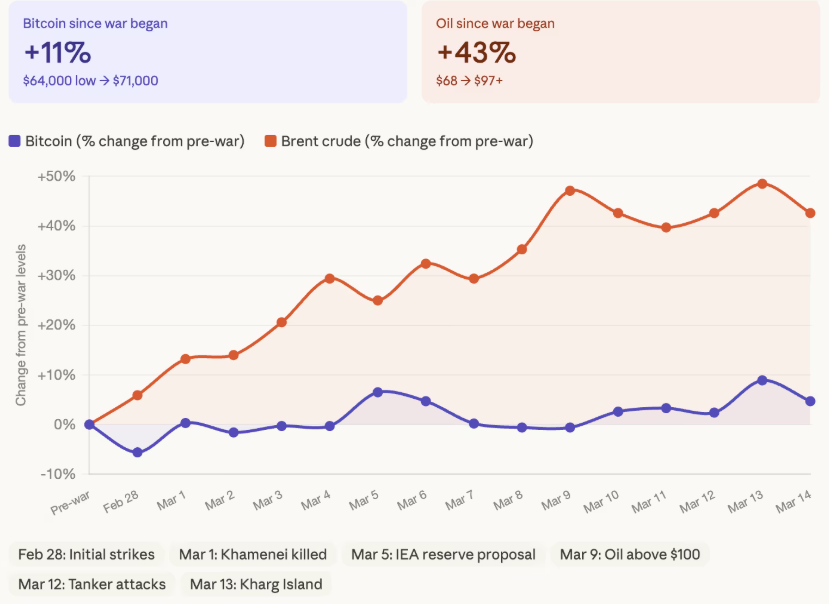
When the US-Iran tension erupted, Bitcoin reacted immediately. On Saturday, the leading cryptocurrency dropped 8.5%, but within two weeks, it rose about 11% from its lowest point and essentially rose from the ashes. While markets are usually paralyzed, Bitcoin has formed higher lows with each new wave of selling.
Market Shock Absorber: Bitcoin
While traditional stock markets were closed, BTC emerged as the only 24/7 liquid market. On February 28, the price dipped to $64,000; on March 2 to $66,000, March 7 to $68,000, March 12 to $69,400, and during the Saturday Harg Island attack, buyers appeared at $70,500. In other words, each wave of selling was met at a higher low than the previous one. This pattern shows that sellers are tiring while buyers are waiting in ambush.
The most striking point is Bitcoin’s performance compared to other assets over the same two-week period. Oil prices have risen more than 40% since the start of the conflict, the S&P 500 remained in a downtrend, gold prices fluctuated, and Asian stock markets recorded their worst week since March 2020. Bitcoin, however, absorbed all this turmoil faster and outperformed other assets.
Critical Squeeze: $74,000 Barrier
Technically, a rising base formed between $64,000 and $70,000. Each negative news triggered selling, but at higher levels than the previous one. During the March 12 tanker attack, the price held at $69,400 and during the Harg Island attack, it did not fall below $70,500. The $73,000–$74,000 range remains a ceiling that has rejected the price four times.
Low Levels:
-
February 28 First Attack: $64,000
-
March 2 Retaliation: $66,000
-
March 7 Continuous Conflict: $68,000
-
March 12 Tanker Attack: $69,400
Clearly, this narrowing triangle is likely to break in one direction.
Macro Context and Resilience
Trump stated that Iran’s energy infrastructure was not targeted; however, if the risk in the Strait of Hormuz continues, it will be reassessed. Iran continues to threaten retaliation on US-linked facilities. This conditional risk could lead to the largest supply disruption in history, according to the IEA.
Fortunately, the Bitcoin market has become leaner and more resilient after the massive liquidation wave in February. Weak hands have been eliminated; geopolitical shocks now fuel a stronger upward move rather than a destructive collapse.
Bitcoin is neither a fully safe haven nor a purely risky asset. When shocks arrive, it is the only traded asset that absorbs them faster than others, functioning as a 24/7 liquidity pool.
Also, you can freely share your thoughts and comments about the topic in the comment section. Additionally, please follow us on our Telegram, YouTube and Twitter channels for the latest news and updates.