

 Haciyev Reşit
A major development has taken place in the U.S. financial sector. The country’s national banking regulator has officially announced that banks may now facilitate the buying and selling of Bitcoin and other crypto assets on behalf of their customers. This step is considered a historic regulatory milestone that significantly narrows the gap between the traditional banking system and the crypto ecosystem in the United States.
Banks Can Now Facilitate Crypto Trading
According to the new guidance published by the U.S. national banking regulator, banks may now take on a brokerage role in crypto transactions. The guidance explicitly states that banks can securely execute crypto purchases and sales for customers, eliminating a long-standing regulatory uncertainty in the sector. With this new framework, banks will be able to offer official crypto services just like traditional investment products, giving customers institutional-grade access to digital assets.
This regulatory clarity something the crypto market has long needed—allows banks to engage in crypto brokerage within a safer, more regulated, and auditable structure. As a result, both retail and institutional clients will find it easier to access crypto assets directly through banks.
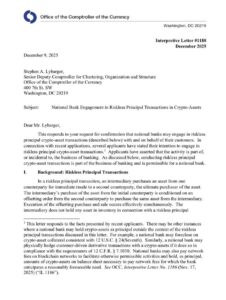
OCC’s New Guidance: “Riskless Principal” Model Approved
The U.S. Office of the Comptroller of the Currency (OCC) stated in its guidance that banks may facilitate transactions known as “riskless principal” trades. Under this model:
- The bank purchases the crypto asset from one party,
- Simultaneously sells it to another,
- And completes the process without holding the asset on its own balance sheet.
The OCC noted that assets may only appear briefly in bank custody under rare circumstances. This structure reduces risk exposure for banks while enabling higher transaction volume.
Political Background of the Regulation
This move is viewed as an extension of the crypto-friendly stance taken by the Donald Trump administration. The administration has long aimed to reduce the divide between traditional finance and the crypto ecosystem, working on regulations to make the two systems more interoperable. The newly issued guidance, which enables banks to have direct access to crypto trading, is seen as a concrete reflection of this supportive policy direction.
Members of the Trump family have openly shown their interest in the crypto sector through political statements and private initiatives. Their support for various crypto projects has accelerated the integration of digital assets into mainstream finance. The newly issued guidance is considered a natural continuation of this trend.
Critics Warn of Systemic Risk
Although the decision was welcomed by the crypto community, some experts issued warnings. According to critics:
- Greater involvement of banks in crypto,
- Could increase the risk of highly volatile crypto market movements spilling into the banking sector.
For this reason, analysts emphasize that the long-term impact of the regulation should be monitored carefully in terms of financial stability.
Previous Restrictions Had Already Been Rolled Back
The OCC’s announcement follows earlier decisions made earlier this year to roll back several crypto restrictions imposed under the Biden administration. In March, the OCC:
- Removed the requirement for banks to obtain pre-approval for crypto activities,
- Eased certain bans on crypto services.
The new guidance marks the next phase in integrating the crypto sector with banking infrastructure.
Assessment
Granting U.S. banks the authority to facilitate crypto transactions represents a major turning point for the industry. This decision could lead to broader adoption of crypto within traditional finance. The ability to buy and sell major assets like Bitcoin through banks may increase institutional demand and contribute to deeper liquidity in the crypto markets. In the coming months, the effects of this regulation on the banking system and the long-term transformation it may spark in the crypto sector will be closely watched.
You can also freely share your thoughts and comments about the topic in the comment section. Additionally, don’t forget to follow us on our Telegram, YouTube, and Twitter channels for the latest news and updates.