

 Emre Yumlu
Debates around the long-term valuation of Bitcoin (BTC) continue to intensify as the digital asset matures and gains wider recognition among global investors. Some market observers argue that Bitcoin’s current valuation may represent only the early stages of a much larger growth cycle.
According to Matt Hougan, Chief Investment Officer at Bitwise, Bitcoin does not need to capture half of gold’s market value to reach a price of $1 million per coin. Instead, the key factor lies in the expansion of the broader global “store of value” market.
The Store-of-Value Market Is Expanding
Many investors assume that for Bitcoin to achieve a seven-figure price, it must directly rival gold and absorb a large portion of its existing market capitalization. Hougan believes this perspective overlooks an important dynamic: the store-of-value market itself is continuously growing.
Gold and other assets commonly used as stores of value have expanded significantly over the past two decades. In 2004, the global gold market was valued at roughly $2.5 trillion. Since then, it has grown at an average annual rate of around 13%, reaching approximately $38 trillion today.
Several structural factors have contributed to this expansion, including rising government debt levels, geopolitical uncertainty, accommodative monetary policies, and increasing concerns about long-term financial stability.
A $121 Trillion Market Within a Decade
If this growth trend continues, Hougan estimates that the total global store-of-value market could reach around $121 trillion within the next ten years.
Under such a scenario, Bitcoin would not need to dominate the market to reach $1 million per coin. Capturing just 17% of the global store-of-value market—roughly one-sixth of the total—could be sufficient to support that valuation.
This framework shifts the discussion away from direct competition with gold and instead highlights the overall expansion of wealth preservation assets worldwide.
Institutional Adoption Could Be a Major Catalyst
Institutional capital is expected to play a critical role in Bitcoin’s potential market share growth. Over the past several years, large financial institutions have gradually increased their exposure to digital assets.
Investment vehicles such as exchange-traded funds (ETFs), sovereign wealth funds, and professional asset managers allocating portions of diversified portfolios to Bitcoin could significantly accelerate adoption.
As these flows increase, Bitcoin’s role within the global financial system may continue to strengthen.
Hougan suggests that when these structural trends are considered, the idea of Bitcoin capturing a meaningful portion of the store-of-value market over the next decade does not appear unrealistic.
Bitcoin and Gold Are Currently Diverging
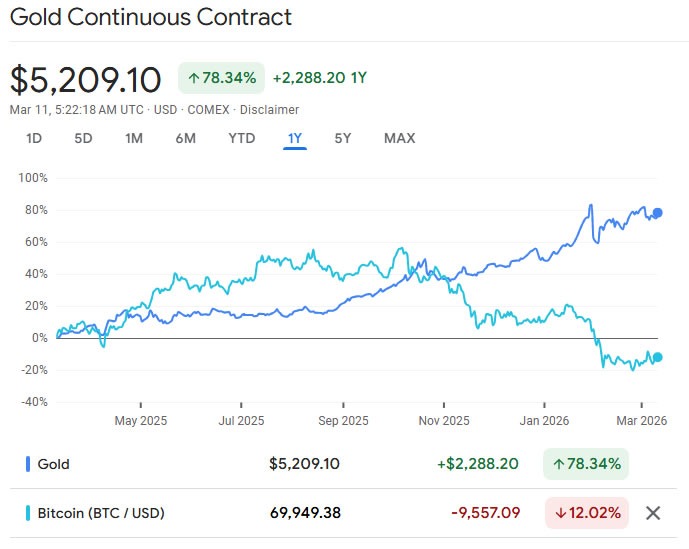
Despite frequent comparisons between Bitcoin and gold, the two assets have not moved in tandem in recent months.
Gold reached an all-time high of $5,600 per ounce in late January and currently remains only about 2.2% below that level. In contrast, Bitcoin is still trading roughly 44% below its peak recorded last October.
This divergence has fueled debate about whether Bitcoin truly behaves like a traditional safe-haven asset, despite its widely used “digital gold” narrative.
The Store-of-Value Narrative Remains Debated
Not all investors are convinced that Bitcoin can fully assume the role of a long-term store of value comparable to gold.
Billionaire investor Ray Dalio has previously expressed skepticism, arguing that gold remains a stronger safe-haven asset. One of his key points is that central banks continue to accumulate gold, while they have not shown the same level of demand for Bitcoin.
Dalio also suggests that Bitcoin’s market behavior often resembles that of technology stocks rather than a traditional defensive asset.
Similarly, some market research indicates that Bitcoin is not currently being priced as a hedge against macroeconomic risks such as inflation, sovereign debt concerns, or real interest rate fluctuations.
A Long-Term Scenario Still Under Discussion
The question of how large a share Bitcoin can ultimately capture within the global store-of-value market remains open. However, the continued expansion of that market combined with increasing institutional participation keeps the long-term bull case alive.
For this reason, some analysts believe that Bitcoin’s current valuation may still represent only an early phase in its long-term price discovery process, particularly if it continues to gain traction as a global wealth preservation asset.
You can also freely share your thoughts and comments about the topic in the comment section. Additionally, don’t forget to follow us on our Telegram, YouTube, and Twitter channels for the latest news and updates.