

 Yeliz Akmaca
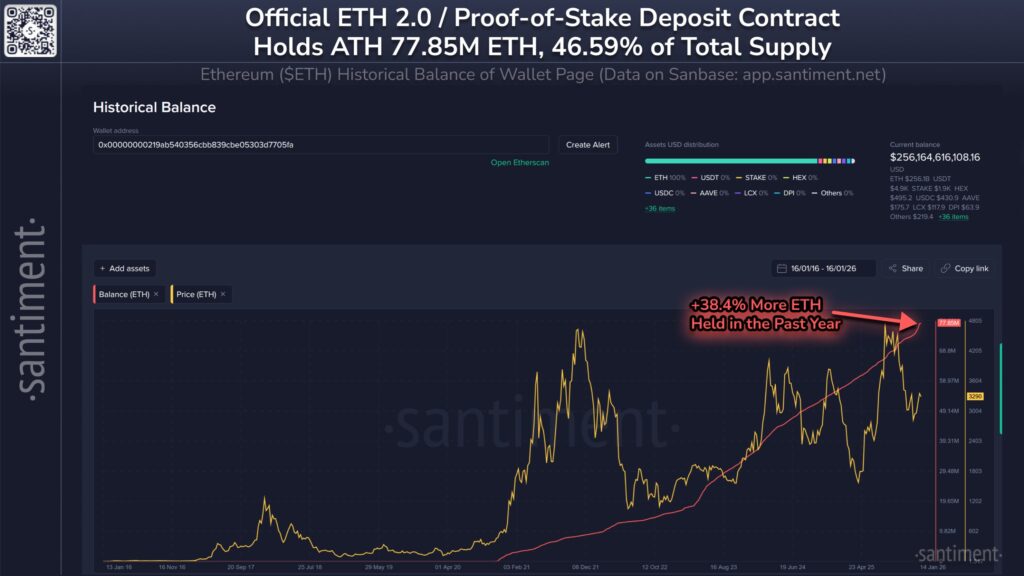
Ethereum Proof-of-Stake deposit contract has reached a new structural milestone. The official staking address now holds approximately 77.85 million ETH, valued at just over $256 billion at current prices. That figure represents 46.59% of Ethereum’s total supply, following a 38.4% increase over the past year.
At first glance, the concentration appears extreme. Nearly half of all ETH sits behind a single contract. But this balance is not a discretionary wallet. It is the foundation of Ethereum’s security model, holding ETH that validators have deliberately locked to secure the network through staking.
Why This Is Not a Whale Wallet
Market intelligence platform Santiment highlighted the milestone over the weekend, noting that the deposit contract is often misunderstood as a potential “whale wallet.” The concern resurfaces periodically on social media, especially during volatile price periods.
In practice, the contract cannot move funds freely, nor can it send ETH directly to exchanges. The Ethereum held there is bound by protocol rules that prioritize network stability over liquidity speed.
Exits Are Designed to Be Slow by Default
Ethereum’s architecture is built to prevent sudden exits. Validator withdrawals are strictly rate-limited at the protocol level. According to ValidatorQueue data, exits are capped at 256 ETH per epoch, translating to roughly 57,600 ETH per day under optimal conditions.
Validators requesting to exit must also wait in a queue, which can stretch into weeks during periods of heavy demand. As of early January 2026, only 288 ETH is waiting to be withdrawn, implying an average delay of roughly seven minutes. The system currently favors inflows, not exits.
Security Over Speed, Even During Stress
This staged withdrawal mechanism acts as a stabilizer. It reduces the risk of validators flooding exchanges during market stress and helps preserve network security during transitional phases.
The design choice is deliberate. Ethereum trades faster exits for resilience, especially when price volatility accelerates.
Staking Participation Keeps Rising Despite Price Pressure
Why this matters becomes clearer when staking participation is examined more closely. Actively staked ETH has reached a record 35.9 million tokens, accounting for 29.6% of circulating supply.
At the same time, the entry queue continues to grow. Roughly 1.32 million ETH is currently waiting to be staked, comfortably outpacing exit demand. This persistence stands out given that ETH still trades roughly 30% below its August 2024 highs near $4,000.
Institutional Weight Is Becoming Harder to Ignore
Institutional involvement is quietly reinforcing the trend. Firms such as BitMine have staked more than 342,000 ETH in recent weeks, while large asset managers are embedding staking into exchange-traded products.
As validator participation scales, influence naturally concentrates. This dynamic keeps decentralization debates alive, even as network security metrics improve.
Where the Market Still Disagrees
Bullish observers interpret the locked supply as a sign of long-term trust. Nearly half of ETH is effectively removed from immediate circulation by participants willing to accept delayed liquidity.
Skeptics focus on a different risk. In the event of a sharp and sustained price decline, a surge in validator exit requests could extend withdrawal queues and delay ETH’s return to liquid markets. Protocol limits soften this risk, but they do not eliminate it.
For now, the data suggests patience rather than panic. Ethereum’s staking contract continues to grow, not drain.
Also, you can freely share your thoughts and comments about the topic in the comment section. Additionally, please follow us on our Telegram, YouTube and Twitter channels for the latest news and updates.