

 Emre Yumlu
The crypto ecosystem has become an integral part of the global financial system thanks to decentralized finance, smart contracts, and digital assets. However, a critical topic often overlooked in the background of this rapid transformation is the foundational security infrastructure of crypto assets. So what is qONE (QONE), and what does it provide?
Today, Bitcoin, Ethereum, and other blockchain networks rely on classic public-key cryptography systems such as RSA, ECDSA, and DSA. While these methods are considered secure against traditional computers, they carry serious vulnerabilities against quantum computers. This is where qONE (QONE) and the underlying qLABS ecosystem come into play.
The Quantum Threat and the Concept of “Q-Day”
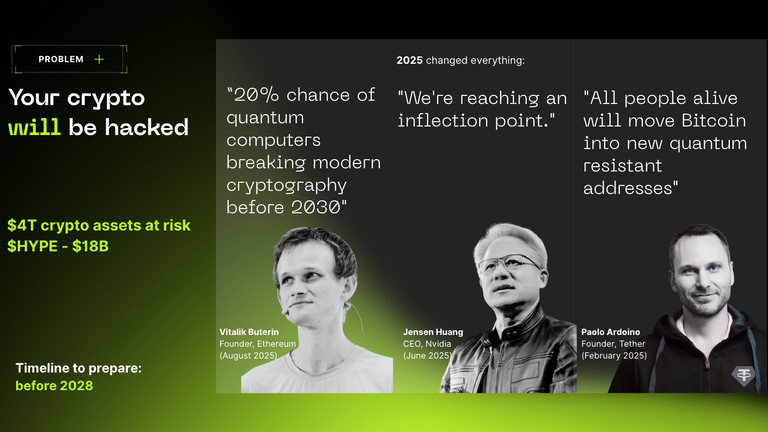
When quantum computers reach sufficient maturity, quantum algorithms such as Shor’s algorithm will make it possible to factor large prime numbers and solve discrete logarithm problems. This development has the potential to render all currently used public-key cryptography systems inoperable.
In such a scenario, private keys could be derived from publicly visible wallet addresses, digital signatures could be forged, and on-chain assets could be seized. This critical threshold is referred to in the literature as Q-Day (Quantum Day).
While it is not yet clear exactly when Q-Day will occur, the risk is no longer purely theoretical. Private keys and signatures created today can be broken retroactively in the future.
What is qLABS? What Does It Aim to Achieve?
qLABS positions itself as the world’s first quantum-native crypto foundation. Its core objective is to prepare the Web3 ecosystem for Q-Day and provide infrastructure capable of protecting approximately $20 billion worth of circulating crypto assets against quantum threats.
To this end, qLABS is developing an integrated product ecosystem built on:
- Quantum-resistant cryptography
- Zero-knowledge proof (ZKP) technologies
- Blockchain-compatible smart contract architectures
At the center of this ecosystem is qONE (QONE).
What is qONE (QONE)?
qONE (QONE) is the first quantum-resistant token issued on the Hyperliquid ecosystem. It also serves as the native token of the qONE Security Protocol and forms the economic backbone of all security layers within the ecosystem.
qONE is not merely a crypto asset; it is designed as:
- A hedge against Q-Day
- The payment unit for Quantum-Sig wallets and secure transactions
- A core element of protocol governance and staking mechanisms
Post-Quantum Cryptography (PQC) and NIST Standards
NIST’s Role The U.S. National Institute of Standards and Technology (NIST) has been the institution defining global cryptography standards such as DES, AES, and SHA since the 1970s. With the quantum threat becoming clear, NIST launched the Post-Quantum Cryptography Standardization Project in 2016.
At the end of this multi-year process, draft standards for quantum-resistant digital signature algorithms were published as of 2024. This development shows that PQC has become an official and implementable security standard rather than an academic concept.
NIST-Selected PQC Algorithms
- CRYSTALS-Dilithium: Lattice-based digital signature system. It stands out as the primary standard due to its balance of speed, security, and practicality.
- SPHINCS+: Hash-based, stateless design that is theoretically extremely conservative.
- FALCON: Another lattice-based algorithm offering smaller signatures and fast verification. Adoption is slower due to implementation complexity.
The qONE Security Protocol aims to make these standards blockchain-compatible.
Why Has the Crypto Ecosystem Fallen Behind?
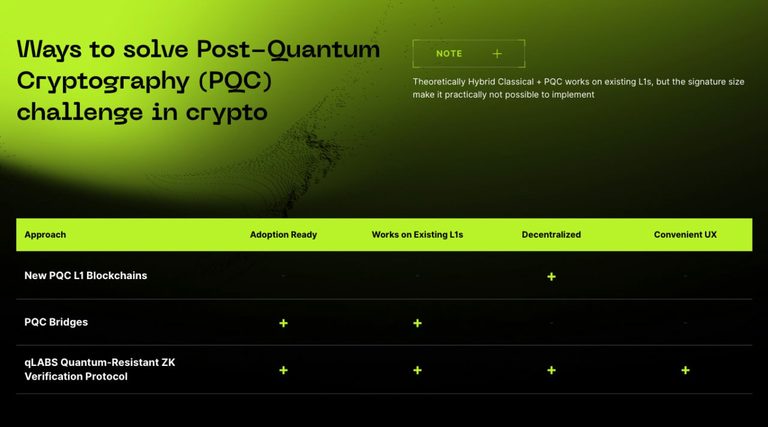
Major technology companies such as Apple, Google, and Microsoft have already begun PQC integrations. In contrast, the main reasons the crypto sector lags behind are:
- Consensus rigidity: Cryptography is foundational to chains, making changes difficult.
- Backward incompatibility: Transitioning to PQC may invalidate existing addresses and keys.
- Technical cost: PQC signatures are 10–100 times larger than classical signatures.
- Resource constraints: Blockchain projects lack the coordination of large technology companies.
qLABS is one of the rare projects aiming to close this gap.
qLABS Product Ecosystem
Security Protocol
The core security layer of the ecosystem. It combines post-quantum cryptography with zero-knowledge proofs to enable quantum-resistant verification of on-chain transactions.
- Dual-signature verification with standard key + quantum-resistant key
- User-toggleable Quantum Factor Authentication (QFA)
- Simple pass/fail verification output for applications
All these processes run in the background without disrupting user experience.
Quantum-Sig Wallet
Quantum-Sig wallet adapts the classic multisig logic to the needs of the quantum era.
- Even if a classic private key is compromised,
- Funds cannot be withdrawn without the quantum-resistant key
- ZKP engine enables verification of large signature data on existing chains
Result: Quantum security at the smart contract level, chain-independent.
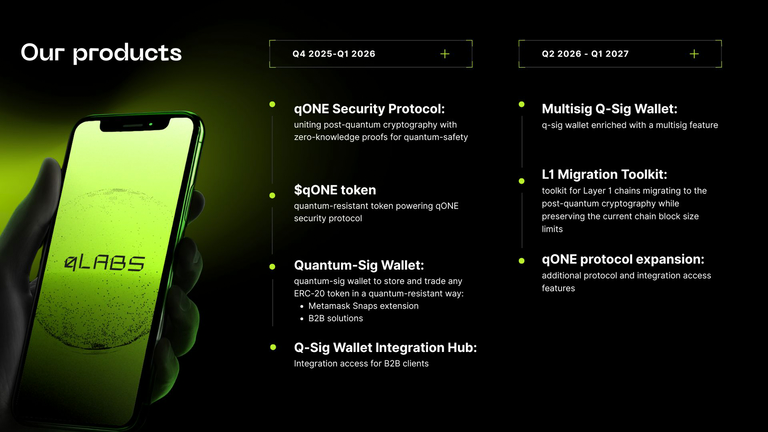
Q-Sig Wallet Integration Hub
For developers and institutional clients:
- SDK
- White-label solutions
- Plug-in integrations
enabling the spread of Quantum-Sig technology on both B2B and B2C sides.
qONE (QONE) Tokenomics
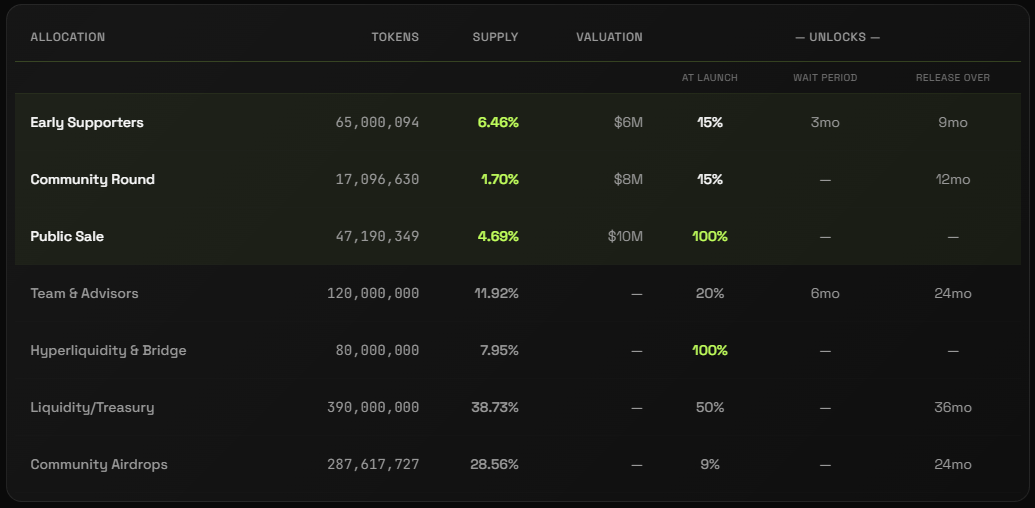
Total supply: 1 billion QONE Network: HyperEVM
- Early Supporters: 6.46%
- Community Round: 1.70%
- Public Sale: 4.69%
- Team and Advisors: 11.92%
- Hyperliquidity and Bridge: 7.95%
- Liquidity / Treasury: 38.73%
- Community Airdrops: 28.56%
qONE Token Use Cases
- Payment of fees for quantum-secure transactions
- Access to Quantum-Sig wallets (QFA)
- Protocol staking
- Governance voting
- Token buybacks funded by fiat revenue
Every secure transaction creates demand for QONE.
qONE Roadmap
Q1 2026 – Launch
- QONE Token
- Security Protocol
- Quantum-Sig Wallet
- Integration Hub
2026 – Scale
- Multisig Wallet
- L1 Migration Toolkit
- Institutional integrations
2027 and Beyond – Expand
- Cross-chain bridges
- DeFi integrations
- Global adoption
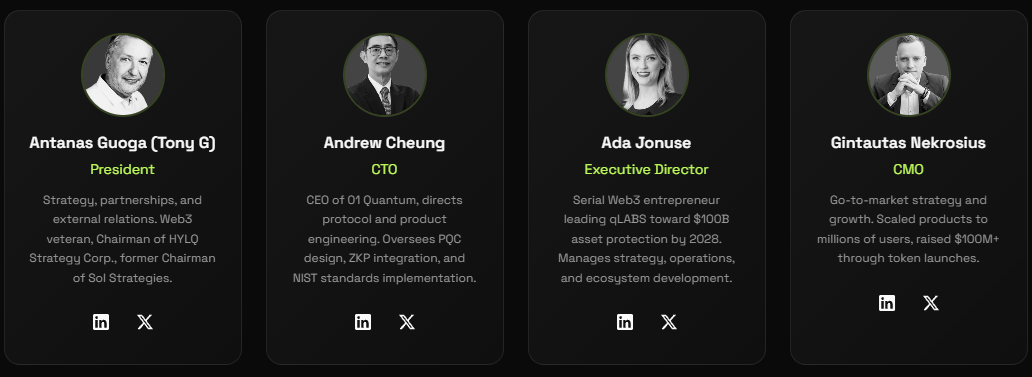
qONE Team
Developed by a team with over 30 years of combined experience in post-quantum cryptography.
- Antanas Guoga (Tony G) – President Strategy, partnerships, and external relations.
- Andrew Cheung – CTO CEO of 01 Quantum, leader of PQC and ZKP architecture.
- Ada Jonuse – Executive Director Operations and ecosystem growth.
- Gintautas Nekrosius – CMO Go-to-market strategies and scaling.
Official Links
You can also freely share your thoughts and comments about the topic in the comment section. Additionally, don’t forget to follow us on our Telegram, YouTube, and Twitter channels for the latest news and updates.