

 Emre Yumlu
Radix (XRD) is a Layer-1 blockchain protocol specifically designed for decentralized finance (DeFi). Aiming to democratize and innovate financial systems, this platform addresses scalability, security, and interoperability challenges to reshape the future of global finance. Radix provides developers with the ability to create secure, modular, and scalable DeFi applications (dApps). The $XRD token supports network transactions, staking, and governance. In this article, we will explore what Radix is, how it works, and the opportunities it offers in detail.
What is Radix (XRD)?
Radix adopts a full-stack approach to remove technological barriers hindering DeFi’s global growth. It stands out with four core technologies:
-
Asset-Oriented Smart Contract Paradigm: As an alternative to Ethereum’s complex Solidity-based development model, Radix Engine and the Scrypto programming language offer asset-oriented smart contracts. This enables dApp developers to write secure and simple code, reducing the risks of hacks and exploits.
-
On-Network DeFi “Lego Bricks”: Radix provides modular and reusable code through the Blueprint Catalog on the network. Developers can easily use standard functionalities like liquidity pools or oracles, accelerating the development process and enhancing interoperability.
-
Self-Incentivizing Developer Ecosystem: Radix’s Developer Royalty System allows developers to earn royalties on every transaction. This encourages the creation of innovative dApps and modular code, reducing reliance on centralized funds.
-
Unlimited dApp Scalability: The Cerberus consensus protocol offers unlimited parallel transaction and dApp scalability. Its “braided” multi-shard consensus maintains atomic interoperability while supporting high transaction volumes.
As of 2025, Radix’s Olympia mainnet release operates with Radix Engine v1; the Babylon release introduces Scrypto and Radix Engine v2, while the Xi’an release will implement full Cerberus consensus.
Radix’s Purpose
Radix aims to transform the exclusionary, slow, and inefficient structure of the 300-year-old traditional financial system, making DeFi the financial standard of the internet age. It addresses issues such as banks’ low interest rates, limited service access, high transfer fees, and crises like 2008. It offers a system where everyone can hold their assets on an open network, and developers can create secure, innovative financial applications. Radix targets financial inclusion for billions of people.
How Radix Works
Radix operates with technologies tailored for DeFi:
-
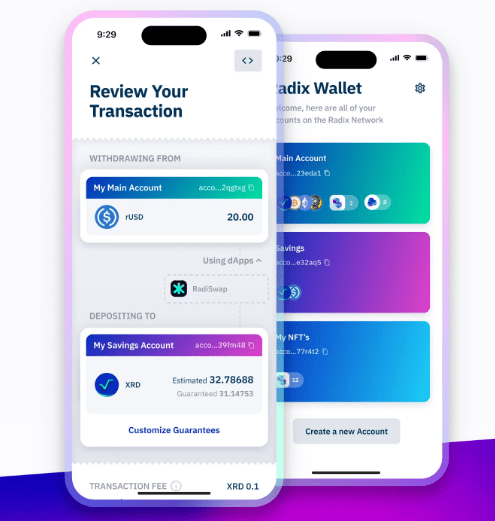
Radix Engine: An asset-oriented smart contract environment. Tokens are defined as “physical” assets at the network level, and accounts function like “vaults” holding tokens. Radix Engine v2 adds powerful smart contract logic with Scrypto; resources are used as tokens, NFTs, and “badges” for authorization.
-
Scrypto: A Rust-based, asset-oriented programming language. Developers can write simple and secure code by moving resources to “buckets” and “vaults.” For example, creating a token requires just a few lines of code; resources are managed by the network, reducing error risks.
-
Blueprint Catalog: Offers modular code templates on the network. Developers can quickly build dApps by using reusable functionalities (e.g., liquidity pools) from the catalog, bringing the open-source development model to a decentralized network.
-
Cerberus Consensus: Operates with unlimited sharding and “braided” consensus. Transactions are processed atomically only on relevant shards, ensuring high throughput and interoperability. Unlike traditional sharding models, Cerberus balances scalability and atomic interoperability.
Radix Roadmap
-
Olympia (Initial): Radix Engine v1 and simplified Cerberus for token transactions.
-
Babylon: Scrypto, Radix Engine v2, and Blueprint Catalog for smart contract support.
-
Xi’an: Full Cerberus consensus for unlimited scalability.
Radix Use Cases
Radix offers versatile use cases for DeFi:
-
Stablecoin and CBDC: Fast, secure, and regulatory-compliant transactions.
-
Tokenization: Tokenizing assets to create opportunities in DeFi and trade finance.
-
Trade Finance: Private chains ensure privacy, while public chains provide transparency.
-
Liquidity Pools and Swaps: Modular components for automated market makers.
-
Digital Identity and Authorization: Badge-based systems for flexible and secure access control.
Radix (XRD) Tokenomics
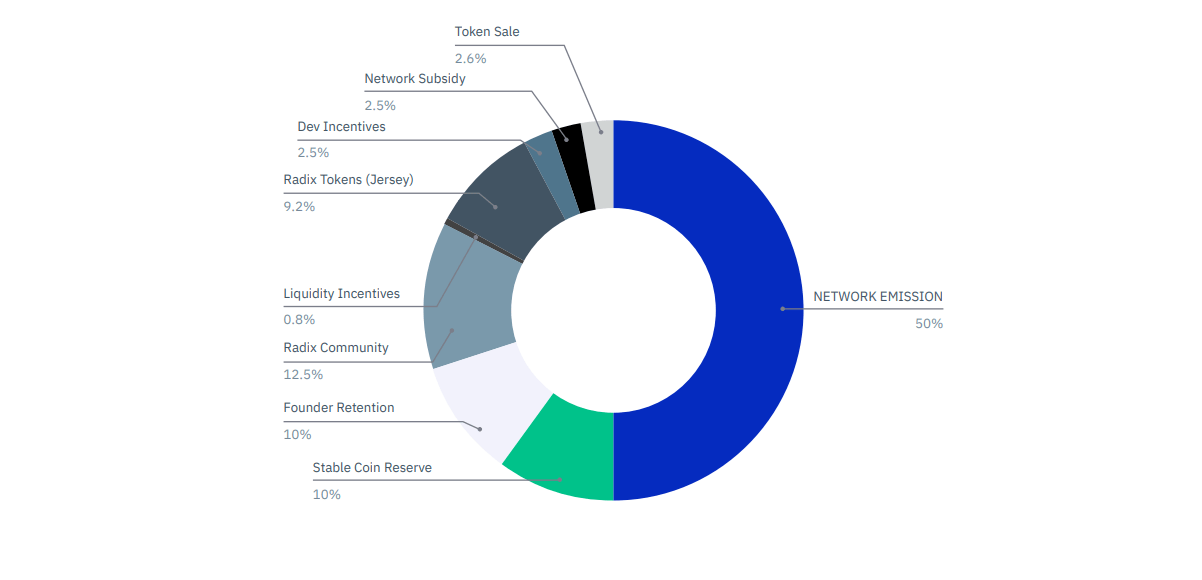
$XRD is the native currency of the Radix network, used for transactions, staking, and governance. The total token supply is 24 billion:
-
Network Emission: 50% (12 billion tokens), distributed over a minimum of 40 years.
-
Community: 12.5%
-
Radix Tokens (Jersey): 9.2%
-
Founders: 10%
-
Stable Coin Reserve: 10%
-
Developer Incentives: 2.5%
-
Network Subsidy: 2.5%
-
Liquidity Incentives: 0.8%
-
Token Sale: 2.6%
Initially, 4.41 billion E-RADIX tokens and 7.59 billion locked XRD tokens were created. Locked tokens are allocated for founders, network subsidy, developer incentives, and the stable coin reserve.
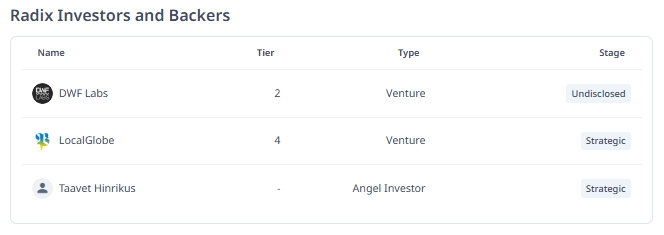
Radix Investors and Backers
Radix is supported by prominent investors and backers such as DWF Labs, LocalGlobe, and Taavet Hinrikus. These partners provide strategic and financial support to strengthen Radix’s vision as a global DeFi platform.
Radix Team
The Radix Foundation manages the project’s open-source development process and aims to build a community-led ecosystem. The team develops innovative technologies like Cerberus consensus, Radix Engine, and the Developer Royalty System. Collaborating with the community, they provide royalty-free core Blueprints and support developers with royalty subsidies in the early stages.
Official Links
You can also freely share your thoughts and comments about the topic in the comment section. Additionally, don’t forget to follow us on our Telegram, YouTube, and Twitter channels for the latest news and updates.