

 Emre Yumlu
In the crypto ecosystem, one of the biggest challenges faced by application developers and data analysts is securely, quickly, and accurately collecting and analyzing data and events from different blockchain networks. This is exactly where Sentio (ST) comes in. Sentio (ST) is a comprehensive platform that provides data monitoring, alerting, and debugging solutions for decentralized applications (dApps). Its main goal is to help developers and analysts better understand on-chain contracts and transactions, thereby optimizing their applications.
Web3 Observability with Sentio (ST)
Sentio is designed as a web3 observability platform. The platform enables developers and analysts to track smart contract events, transactions, traces, and states from multiple blockchain networks such as Ethereum, Aptos, Polygon, and Avalanche. This process is made very easy with Sentio’s provided SDK (Software Development Kit). The SDK automatically performs data indexing operations to turn raw blockchain data into meaningful and usable insights.
Users can visualize this data, create alerts, and perform advanced log searches through the web interface. The features offered by Sentio allow developers to monitor their dApps in real time and detect potential issues early.
The platform’s standout capabilities include:
- Real-Time Data Monitoring: Events and transaction data from smart contracts are collected and analyzed instantly.
- Alerts and Notifications: Custom alerts can be created for critical events or anomalies.
- Advanced Log Search: Detailed and customizable searches can be performed on transaction history, event logs, and contract states.
- Multi-Chain Support: Data from different blockchain networks can be collected and analyzed within a single project.
Core Mission of Sentio (ST)
Sentio aims to build “the next generation of crypto data infrastructure” by taking into account the speed, scale, and complexity of modern blockchain applications. The platform’s core mission is to provide developers with fast, reliable, and flexible data tools so they can focus on their primary work—product development.
Accordingly, Sentio goes beyond being just a data indexing system; it offers users meaningful data insights, monitoring, and development capabilities. With Sentio, developers can accelerate data collection and analysis processes while also improving the security and performance of their dApps.
Use Cases and Advantages
The platform offered by Sentio stands out in two main use cases:
- Collecting and Utilizing Crypto Data Sentio SDK provides an optimized framework for collecting and processing blockchain data.
- Automatic TypeScript Types: TypeScript types are automatically generated to define smart contract events without requiring users to configure manually.
- Custom Indexing Logic: Ideal solution for projects that need not just raw data but processed and meaningful data collection.
- High Parallelism: Offers up to 100x faster data collection capacity compared to traditional indexing frameworks.
- Advanced Triggers and Functions: Allows customization of data flows with custom triggers beyond standard event indexing.
- Integrated Dashboard and Alerts: Zero-configuration real-time project monitoring, visualization of critical metrics, and creation of custom alerts for anomalies.
- Advanced API and Querying: Data access or creation of custom endpoints via GraphQL and SQL editors.
- Multi-Chain and Version Support: Ability to manage different blockchain networks and contract versions within a single project.
- Accelerating Development Processes Sentio also provides tools that speed up dApp development:
- Debugging: Detailed inspection of transaction execution with call traces, fund flows, balance changes, and gas profiling.
- Transaction Simulation: Fast simulation of complex and bundled transactions.
- Dynamic Logging: Observing on-chain states by adding console logs directly to smart contracts.
- Code Search: Quickly finding required code in on-chain deployed contracts.
Sentio Network and Decentralized Structure
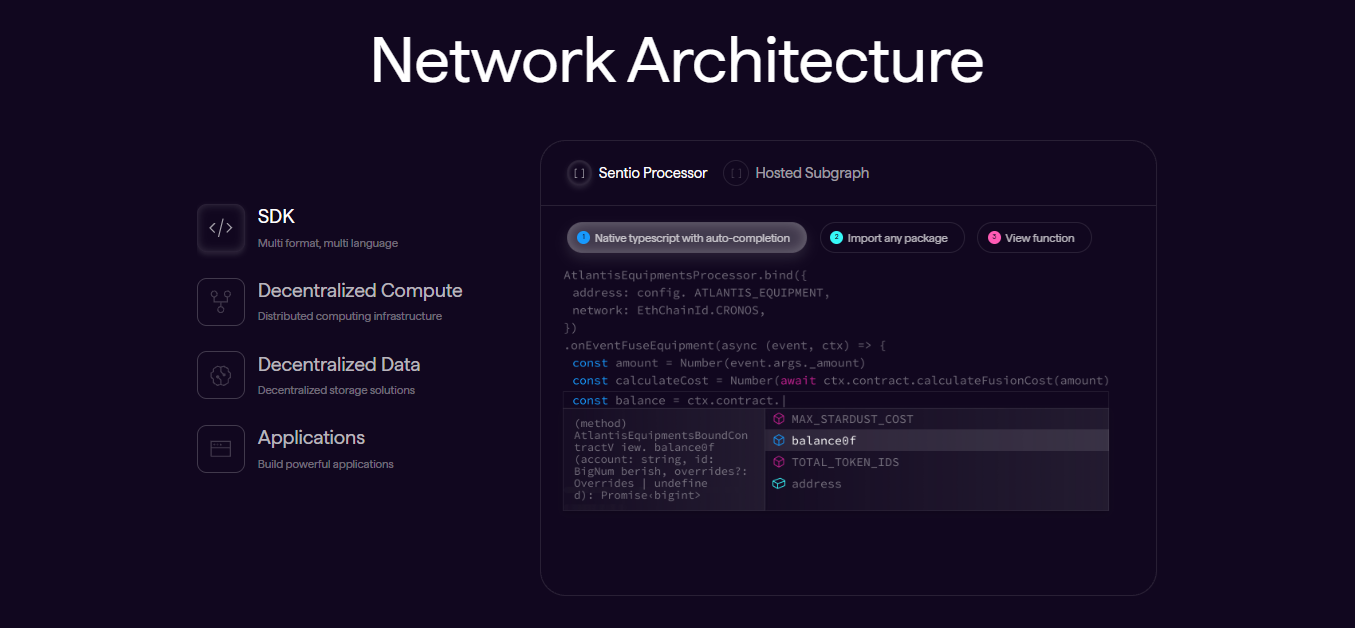
The Sentio platform is being transitioned to a decentralized structure through Sentio Network. This structure ensures that data storage and processing layers are executed by distributed node participants instead of a centralized provider. This approach enables verifiable and secure data processing, as well as appropriate distribution of incentives for node operators, developers, and users.
Core Principles
- Developer-First and Modular: Processors, dashboards, and alerts are designed to be user-friendly, fast, and modular.
- Reliable and Incentive-Driven: Eliminates dependency on centralized providers; the economy is transparent and usage-focused with the $ST token.
- AI-Native: Natural language queries, automatic debugging, and predictive analytics are at the core of the system.

Sentio Network Architecture
Sentio Network consists of three main components: Processor, Sentio Network, and Applications.
-
Processor: User-defined programs that transform raw blockchain data into meaningful and actionable insights.
-
Sentio Network Layers:
- Compute Layer: Provides real-time processing, aggregation, and analysis.
- Data Layer: Stores blockchain and processor-indexed data, provides access via API and SQL-like queries.
- Sentio EVM: Built on OP Stack; stores metadata of data layers, supports staking and voting mechanisms.
This structure allows independent scaling of processing and data layers. For example, a processor can have copies running in two different continents, and the generated data can be replicated across different nodes.
- Applications: Various projects such as the Sentio platform, AI applications, and decentralized applications can be built on Sentio Network.
Network Participants
- Developers and Analysts: Create processors and use indexing, querying, and RPC services.
- Node Operators: Run processors, store data, and serve queries; earn SU per transaction and gain reputation.
- Stakers / Delegators: Earn passive income by delegating $ST tokens to node operators.
Sentio (ST) Tokenomics
Sentio Token ($ST) is both the native governance and utility token of the platform:
- Payment: Sentio Units (SU) are used for access to blockchain data, and payments are made with $ST. Payments are distributed to node operators and stakers, with a small portion burned for economic balance.
- Staking: $ST is staked for node participation; users can delegate stakes. Misbehavior is penalized through slashing.
- Governance: $ST holders can vote on protocol-level parameters and upgrades.

Sentio (ST) Investors
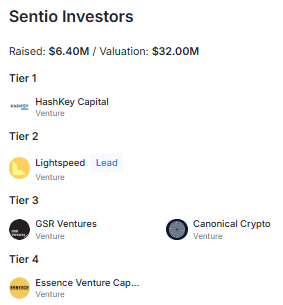
Sentio has raised a total of $6.4 million and reached a $32 million valuation. Its investors are ranked in different tiers as follows:
- Tier 1: HashKey Capital
- Tier 2: Lightspeed
- Tier 3: GSR Ventures, Canonical Crypto
- Tier 4: Essence Venture Capital
Sentio (ST) Team
The Sentio team consists of individuals experienced in blockchain observability and data:
- Fuyao Zhao – Co-Founder & CEO
- Chongzhe Li – Co-Founder

Official Links
Feel free to share your thoughts on the topic in the comments. Besides, don’t forget to follow us on Telegram, YouTube, and Twitter for more analysis and updates.