

 Emre Yumlu
Union (U) is a zero-knowledge (ZK) interoperability protocol designed to enable fast, secure, and decentralized communication between blockchain networks. Fully compatible with Cosmos’ Inter-Blockchain Communication (IBC) protocol, Union offers a more efficient, rapid, and flexible infrastructure for developers. It facilitates asset transfers across chains like Ethereum, Arbitrum, Scroll, Beacon Kit, and Movement without relying on centralized intermediaries, oracles, or multi-signature systems. Union’s CometBLS consensus mechanism and Galois zero-knowledge proof system provide an innovative approach to secure bridging and low-cost transactions, enhancing the scalability of Web3 and DeFi ecosystems.
What is Union (U)? What Does It Aim to Achieve?
Union aims to deliver a secure, fast, and cost-effective interoperability solution for the blockchain ecosystem. It overcomes the centralization, high costs, and performance limitations of traditional bridging systems through zero-knowledge technology. CometBLS provides an optimized consensus mechanism tailored for ZK proofs compared to Tendermint, while Galois generates proofs for 128 validators in just 7 seconds, ensuring a low-cost, censorship-resistant, and decentralized system. Union makes cross-chain asset transfers secure and transparent, supporting the development of DeFi protocols and Web3 applications on a decentralized infrastructure. By enhancing horizontal scalability, Union strengthens Web3’s potential to become a global financial system.
CometBLS and Galois
CometBLS is Union’s consensus mechanism, leveraging Boneh-Lynn-Shacham (BLS) signatures to reduce transaction verification costs. This system supports hundreds of validators and offers resilience against quantum attacks. BLS signatures enable aggregated verification, reducing transaction size and on-chain computation costs compared to ECDSA. The MiMC hash function enhances performance in ZK circuits, further optimized in CometBLS V3. Epoch-based validator rotation minimizes light client updates, boosting relayer profitability and lowering user fees. Future enhancements, such as Verkle Trees, will further reduce proof times and costs.
Galois, Union’s zero-knowledge proof system, is built on three core principles: speed, low cost, and censorship resistance. Using the Gnark zk-SNARK library and gRPC, Galois generates proofs for 128 validators with 5GB of RAM in 7 seconds, enabling proof production on entry-level consumer laptops. This reduces reliance on expensive cloud infrastructure and promotes decentralization. Planned upgrades include Verkle Tree support, formal verification with Lean, and proof caching to minimize redundant work and encourage decentralized sequencer orchestration.

Connections and Channels
Union replaces single-chain connections with multi-connection and channel standards. Direct connections enable single-hop communication, while recursive connections support multiple hops via statelens. Each connection encodes a finality mechanism (e.g., soft or hard finalization on Arbitrum) and security level. Channels support various protocols and operate independently of connection type. This design abstracts complexity for developers and users, making connections function like simple sockets. Union’s Voyager relayer uses finite state machines to ensure data integrity and fast startup times, processing transactions in parallel for enhanced speed and reliability.

Union (U) Tokenomics
The Union token (U) is an ERC-20 token with a total supply of 10 billion and an initial circulating supply of 1,919,050,000. As the network’s native gas token, U serves three primary functions:
-
Dynamic Fee Market: Used for proof aggregation, light client updates, and cross-chain operations. Participants can pay higher fees for priority transactions.
-
Network Security: Validators and delegators stake U to secure the network and earn rewards. Cross-chain staking supports participation from chains like Ethereum.
-
Cross-Chain Governance: U holders vote on parameter changes, validator updates, and protocol upgrades, contributing to governance decisions.
Token Distribution
-
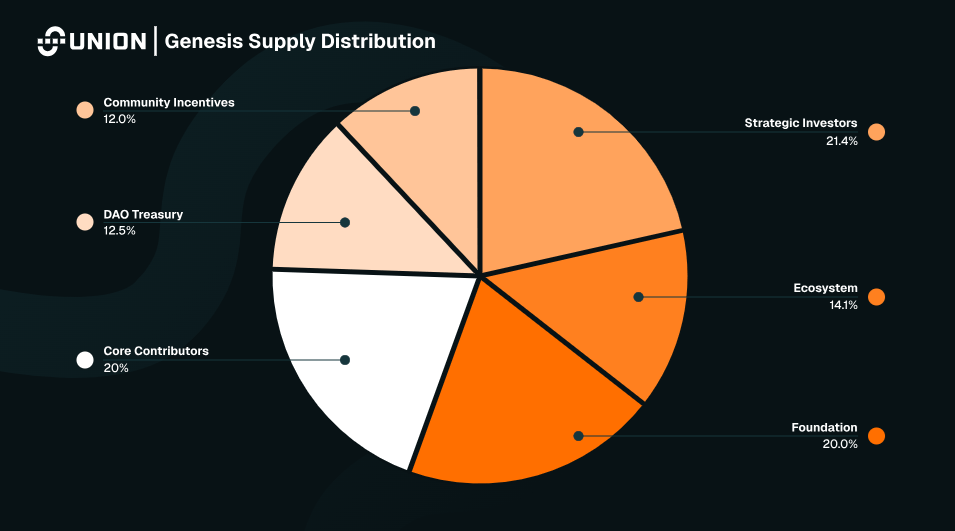
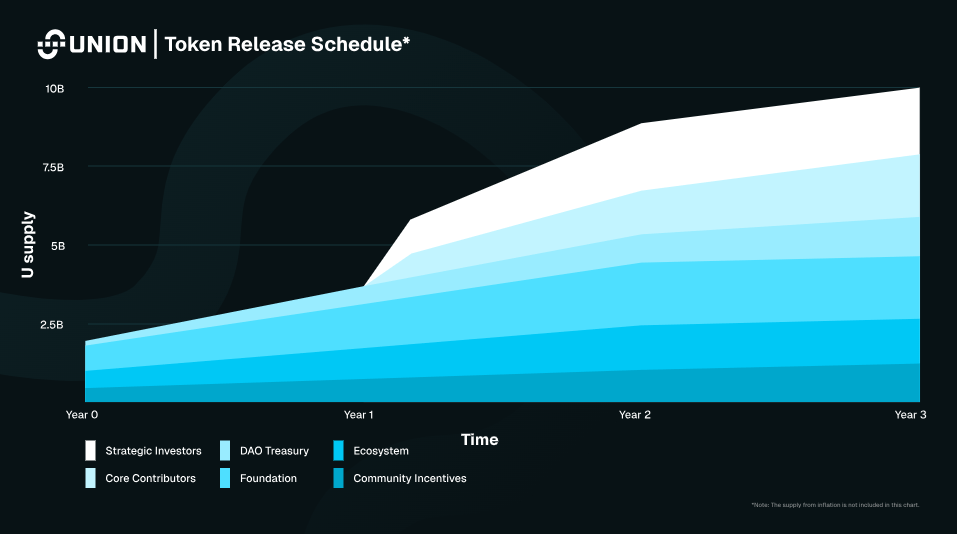
Community Incentives: 12% (4% at TGE, 8% for future airdrops and liquidity incentives)
-
Ecosystem: 14.1% (40% at TGE, 2-year linear vesting; for developer programs, grants, and partnerships)
-
DAO Treasury: 12.5% (12.5% at TGE, 3-year linear vesting; for community-driven governance)
-
Foundation: 20% (40% at TGE, 2-year linear vesting; for network development and operations)
-
Strategic Investors: 21.4% (1-year cliff, 1-year linear vesting)
-
Core Contributors: 20% (1-year cliff, 2-year linear vesting)
U launches with a 6% annual inflation rate, decreasing by 10% yearly until reaching a long-term rate of 2%. Staking rewards for locked tokens are locked for 12 months and managed by the Union Foundation for ecosystem incentives. The Union Staking Vault, integrated with Tower DEX’s U/eU pool, offers 120-140% reward rates through liquidity provision and arbitrage. Users receive vU tokens representing their vault positions.
Union (U) Investors
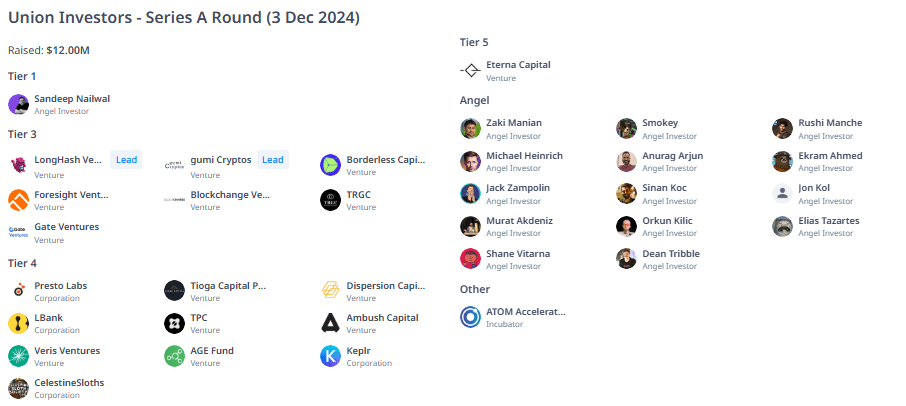
Union has raised $12 million, with investors including Sandeep Nailwal (angel investor), LongHash Ventures, gumi Cryptos, Borderless Capital, Foresight Ventures, Blockchange Ventures, TRGC, Gate Ventures, Presto Labs, Tioga Capital Partners, Dispersion Capital, LBank, TPC, Ambush Capital, Veris Ventures, AGE Fund, Keplr, CelestineSloths, and angel investors Zaki Manian, Rushi Manche, Michael Heinrich, Anurag Arjun, Ekram Ahmed, Jack Zampolin, Sinan Koc, Jon Kol, Murat Akdeniz, Orkun Kilic, Elias Tazartes, Shane Vitarna, Dean Tribble, and ATOM Accelerator.
Union Team
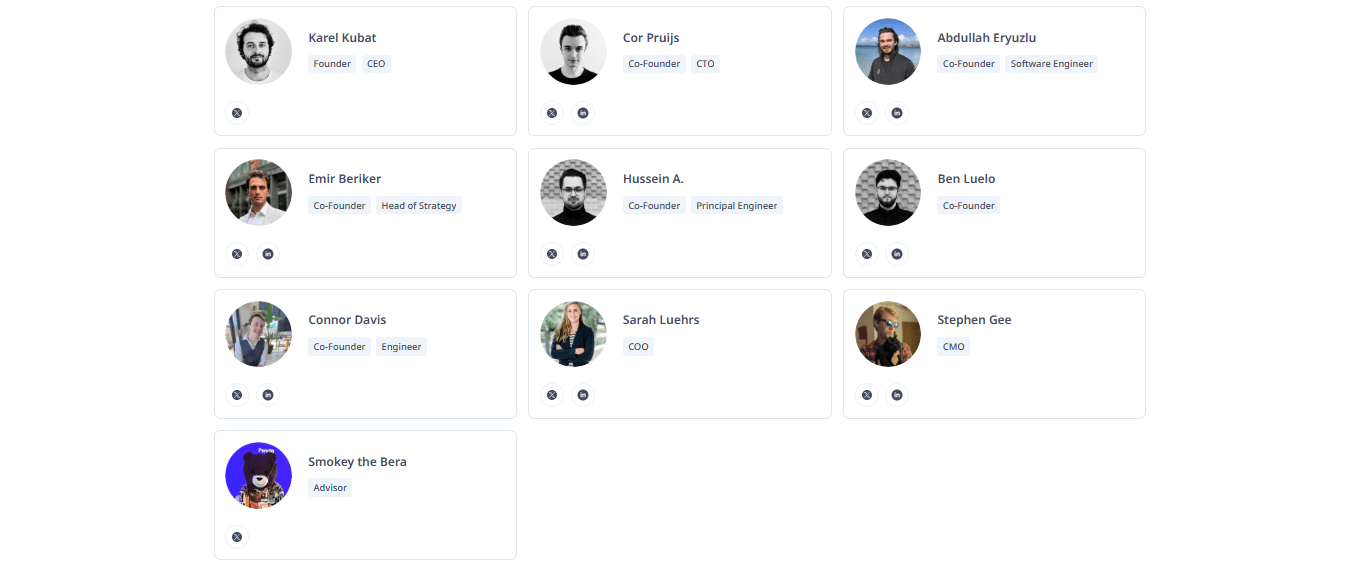
Union is led by a skilled team:
-
Karel Kubat: Founder and CEO
-
Cor Pruijs: Co-Founder and CTO
-
Abdullah Eryuzlu: Co-Founder and Software Engineer
-
Emir Beriker: Co-Founder and Head of Strategy
-
Hussein A.: Co-Founder and Principal Engineer
-
Ben Luelo: Co-Founder
-
Connor Davis: Co-Founder and Engineer
-
Sarah Luehrs: COO
-
Stephen Gee: CMO
-
Smokey the Bera: Advisor
Union leverages zero-knowledge technology to build a secure, fast, and cost-effective bridge between blockchains, empowering the future of DeFi and Web3. Its decentralized and scalable infrastructure supports horizontal scalability and establishes a reliable interoperability standard.
Official Links
You can also freely share your thoughts and comments about the topic in the comment section. Additionally, don’t forget to follow us on our Telegram, YouTube, and Twitter channels for the latest news and updates.