

 Emre Yumlu
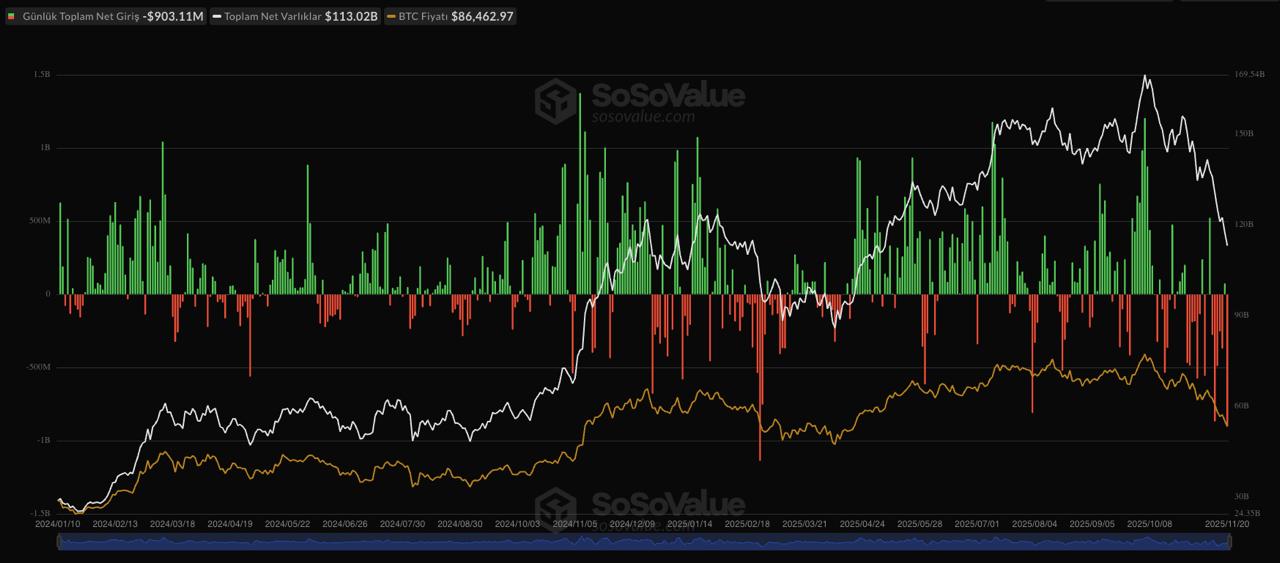
Bitcoin has remained under significant pressure in recent weeks, drawing attention from investors worldwide. Mixed macroeconomic signals from the United States, fading expectations of Federal Reserve rate cuts, and heavy withdrawals from crypto-related ETFs have collectively weighed on market sentiment. As a result, BTC slid to around $82,000, marking its lowest level since April.
A Historic Day for ETF Outflows
On November 20, 2025, the ETF market experienced one of its most intense days of selling. Bitcoin ETFs recorded $903 million in net outflows, while Ethereum ETFs saw an additional $261 million leave the market. For Bitcoin ETFs in particular, this level of withdrawal stands among the highest ever observed and underscores the severity of the current sell-off.
The Main Driver: Retail Selling in Spot ETFs
According to JPMorgan analysts, the latest downturn can be largely attributed to retail investors exiting spot Bitcoin and Ethereum ETFs.
Citing research led by Nikolaos Panigirtzoglou, the team observed that individual investors sold roughly $4 billion worth of spot BTC and ETH ETFs throughout November. This wave of redemptions has been identified as the primary catalyst keeping the crypto market under pressure.
While October’s correction was driven by heavy deleveraging in perpetual futures markets, JPMorgan notes that those leveraged positions have since stabilized. Instead, November’s sell-off was dominated by non-crypto-native retail participants, whose ETF withdrawals extended the market’s decline.
VanEck: Medium-Term Holders Are Selling, Long-Term Investors Holding Steady
VanEck’s analysis offers further insight into the behavior of different investor groups. The firm highlights that the latest wave of selling largely came from medium-term holders, not long-term BTC investors. Addresses that have held Bitcoin for up to five years accounted for much of the recent selling activity, while long-term holders remained mostly inactive despite weakening sentiment.
VanEck also reports that balances in wallets holding BTC for three to five years have dropped by 32% over the past two years. This shift is described not as capitulation, but as a rotation among investor types.
Additionally, open interest in perpetual futures has fallen 20% since October 9, and funding rates have returned to levels typically seen during bearish phases. According to VanEck, these conditions suggest Bitcoin has entered a “reset” phase—one that historically precedes periods of recovery.
You can present your own thoughts as comments about the topic. Moreover, you can follow us on Telegram and YouTube channels for this kind of news.