

 Emre Yumlu
The Quantum Resistant Ledger (QRL) is a cutting-edge blockchain platform, externally audited and enterprise-grade, designed to remain secure against tomorrow’s quantum computing advancements. QRL pioneers the first industrial implementation of the IETF-specified eXtended Merkle Tree Signature Scheme (XMSS), a hash-based, forward-secure signature method endorsed by NIST, featuring minimal security assumptions and reusable addresses. From its genesis block, QRL integrates quantum-resistant address formats. Its open-source codebase is verified through third-party audits by red4sec and x41 D-sec. Tailored for developers, QRL provides comprehensive documentation and API references, empowering users to build applications on a robust platform ready for the quantum era.
QRL simplifies blockchain interaction with user-friendly applications, including desktop (Windows, Mac, Linux), mobile (iOS, Android), and web wallets, shielding users from the complexities of quantum-resistant technology. This article explores QRL’s essence, functionality, advantages, risks, and tokenomics in detail.
What is Quantum Resistant Ledger (QRL)?
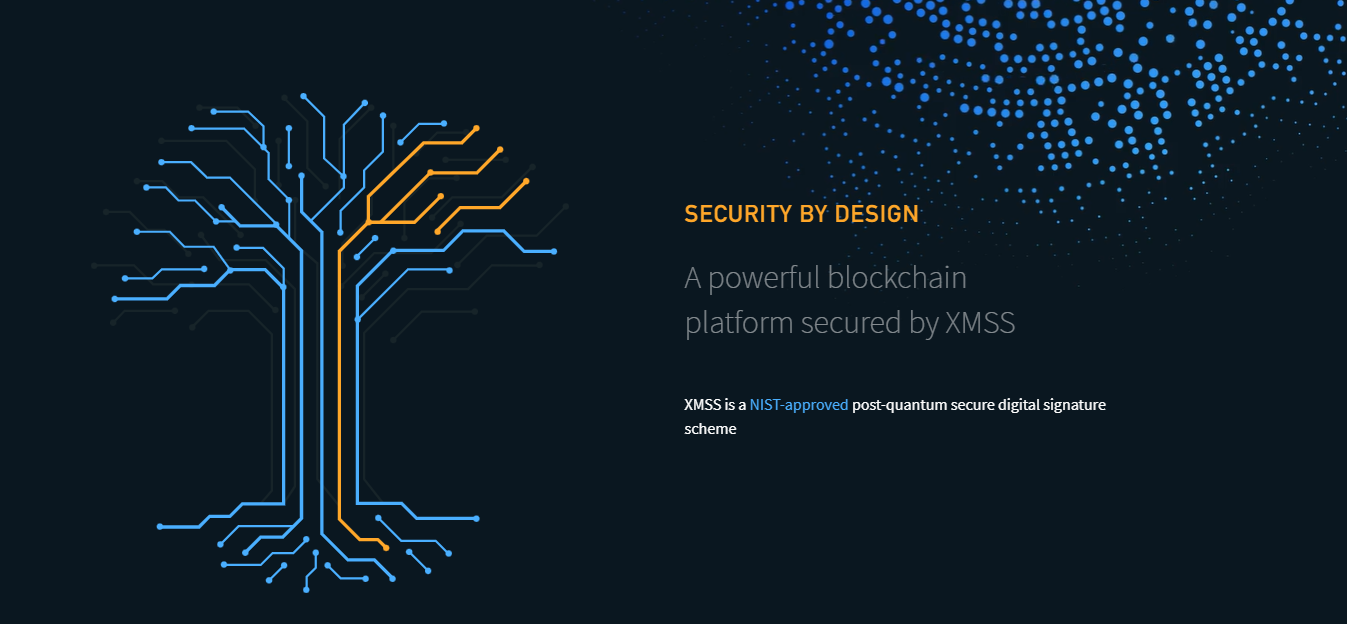
QRL is an innovative blockchain platform engineered to protect against quantum computing threats. Traditional blockchains rely on elliptic curve cryptography (ECDSA), which is challenging for classical computers but vulnerable to quantum computers using Shor’s algorithm. QRL addresses this by implementing XMSS, a NIST-approved, hash-based scheme that ensures quantum-resistant security.
Its open-source codebase, validated by third-party audits from red4sec and x41 D-sec, guarantees reliability. QRL offers developers extensive APIs and documentation, enabling the creation of secure applications for the quantum age. With desktop, mobile, and web wallets, QRL ensures seamless user onboarding, with Quanta serving as its native currency. By securing blockchain signatures with XMSS, QRL enhances immutability and resilience against quantum attacks, allowing users to transact, mine, or run nodes in an accessible ecosystem.
Purpose of QRL
QRL’s mission is to deliver enterprise-grade security to the blockchain ecosystem, with a focus on safeguarding against quantum computing threats. Unlike traditional blockchains that depend on ECDSA, which quantum computers could compromise, QRL employs XMSS from its genesis block. This forward-secure signature scheme, with minimal assumptions, protects assets and transactions in the quantum era.
QRL provides an open-source infrastructure, reinforced by third-party audits for transparency. Its user-friendly wallets and APIs make blockchain technology accessible, while its quantum-resistant address format strengthens transaction security. QRL aims to be a reliable foundation for developers and users, ensuring blockchain’s longevity in a quantum future.
How Does QRL Work?
QRL is built on hash-based cryptography, with XMSS ensuring quantum-resistant addresses. Each address generates a Merkle tree composed of One Time Signature (OTS) key indices. By default, a tree height of 10 provides 1024 OTS indices, each usable for only one transaction, a cornerstone of QRL’s quantum security. Private keys (mnemonic phrase or hexseed) regenerate the Merkle tree, while the public address is a 79-character hexadecimal string prefixed with “Q.” Larger tree heights offer more OTS indices but increase wallet opening times.
Wallets
QRL offers diverse wallet options to meet user needs:
-
Web Wallet: Accessible at it enables address creation, transactions, and network tool access. XMSS operations run via WebAssembly in the browser, with private keys erased upon closing the wallet.
-
Desktop Wallet: Available for Windows, Mac, and Linux, it opens addresses using hexseed, mnemonic, or wallet.json files.
-
Ledger Wallet: A hardware wallet stores private keys offline, requiring physical authorization for transactions.
-
Mobile Wallet: Supports iOS and Android for transactions and balance checks but will be delisted from app stores on May 30, 2025. Users must back up wallets and transition to alternatives.
-
Offline Wallet: Air-gapped address creation ensures internet-free security, with private keys stored securely.
Balance Lookup
QRL’s blockchain immutably records address balances. Methods include:
-
Block Explorer: Displays balance and transaction history using the public address.
-
Wallets: Show balances upon opening with private keys.
-
Command Line Tools: Enable advanced queries via APIs, with public key usage recommended.
Mining
QRL uses the RandomX Proof-of-Work (PoW) consensus algorithm, optimized for CPUs to resist ASIC/GPU mining. Miners use tools like XMR-Stak to earn rewards. Options include:
-
Solo Mining: Runs on a full node, offering full block rewards but with lower success odds.
-
Pool Mining: Combines CPU hashrate, distributing rewards based on contribution.
Nodes
QRL nodes validate transactions, mint blocks, and maintain immutable history. The P2P network ensures consensus, while APIs provide developer access. Nodes collect transactions from the mempool and integrate them into the blockchain, forming the distributed ledger’s core.
Service Status
The QRL Foundation monitors services, providing updates on the web wallet, Block Explorer, and nodes. Email notifications alert users to outages.
API
QRL’s APIs, built on gRPC, use qrl.proto to offer developers access to blockchain functions. Running a personal node is the best practice.
QRL Use Cases
QRL supports:
-
Cryptocurrency Storage: Quantum-resistant wallets for secure asset holding.
-
Mining: Earning Quanta via CPU mining.
-
Development: Building DApps with APIs.
-
Node Operation: Contributing to network security.
Usage Steps:
-
Create an address using the web wallet.
-
Securely back up private keys (mnemonic or hexseed).
-
Check balances via the Block Explorer.
-
Mine Quanta with mining software.
-
Develop applications or run a node using APIs.

Advantages of QRL
-
Quantum-Resistant Security: XMSS protects against Shor’s algorithm.
-
Open-Source Transparency: Audited by red4sec and x41 D-sec.
-
User-Friendly: Supports web, desktop, mobile, and offline wallets.
-
Developer-Centric: Robust APIs and documentation.
-
Secure Signatures: OTS indices ensure single-use signatures for enhanced security.
QRL Tokenomics
QRL manages inflation and emission for long-term stability:
-
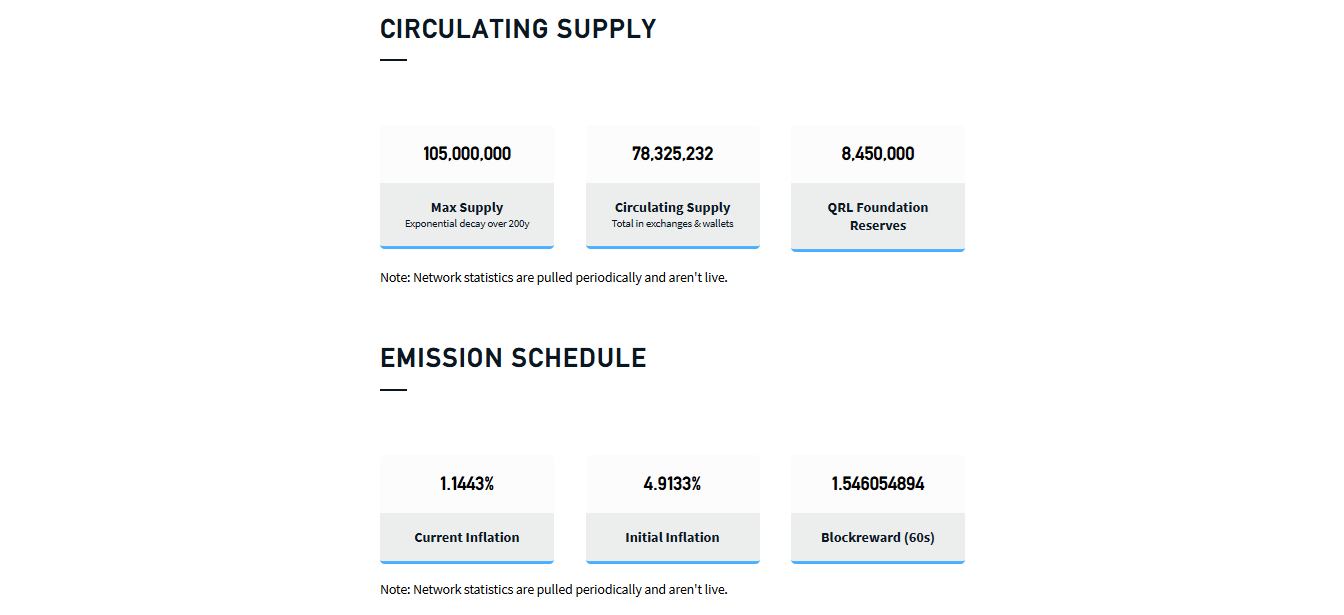
Circulating Supply: 78,325,232 Quanta.
-
Maximum Supply: 105,000,000 Quanta, reached via exponential decay over 200 years.
-
Initial Inflation: 4.9133%; current: 1.1443%.
-
Block Reward: 1.546054894 Quanta (60 seconds).
-
Initial Supply: 52,000,000 public, 13,000,000 reserved (8,000,000 for QRL Foundation).
-
Emission: 40,000,000 Quanta distributed over 200 years, with 1 trillion QUs per epoch.
-
Mining: RandomX PoW, with PoS in development.
The tokenomics structure uses exponential decay for sustainability, with mining rewards incentivizing network participation. QRL Foundation reserves support distribution and development.
QRL Partnerships
QRL collaborates with strategic partners to advance quantum-resistant technology:
-
Die QRL Stiftung: Governance and funding.
-
Geometry Labs: Technical development and research.
-
MerkleTree Labs: Cryptographic innovation.
-
Quantum Compliance Limited: Regulatory compliance.
-
Quantum Future Limited: Forward-looking solutions.
-
Singularity Systems: System integration.
-
Volt Development: Development support.
These partnerships bolster QRL’s ecosystem, enhancing security and scalability.

QRL Team
The QRL team comprises experts in blockchain and quantum-resistant technology:
-
Peter Waterland (Founder & Developer): Shapes QRL’s vision and leads technical efforts.
-
Kaushal Kumar Singh (Core Developer): Drives the platform’s technical infrastructure.
The team is committed to open-source principles, working transparently with the community.

Official Links
Also, in the comment section, you can freely share your comments and opinions about the topic. Additionally, don’t forget to follow us on Telegram, YouTube and Twitter for the latest news and updates.