

 Emre Yumlu
Block Street (BSB) is a blockchain venture aiming to build an institutional-grade infrastructure layer for tokenized capital markets. The project’s core objective is to consolidate fragmented tokenized asset liquidity across different chains and issuers, creating what it defines as a “Unified Liquidity Layer” — an integrated liquidity backbone. This structure aims to enable seamless capital flows between traditional finance (TradFi) and decentralized finance (DeFi).
Initially positioned as a lending protocol focused on tokenized assets, Block Street has evolved to address a more fundamental market problem: liquidity fragmentation and execution inefficiency. Today, the project positions itself as an upper-layer infrastructure “plumbing” necessary for on-chain capital markets to function effectively.
What Does Block Street (BSB) Aim For?
Block Street is not merely a product; it is a holistic financial architecture aiming to build the foundational infrastructure backbone required for tokenized capital markets to operate. $BSB serves as the economic and governance center of this structure.
While tokenized stocks and real-world assets (RWA) continue to grow, infrastructure shortcomings limit the scalability of this market. Block Street acts as a bridge that combines execution quality, liquidity depth, and risk management with TradFi standards and DeFi programmability.
Eliminating Fragmentation with Block Street (BSB)
As tokenized stocks and real-world assets (RWA) expand, liquidity remains scattered across different chains, protocols, and issuers. This fragmentation creates costs such as price deviation, wide spreads, and capital inefficiency. Block Street’s vision is to eliminate this fragmentation tax.
The project has identified that investors currently face tracking errors of 0.6–0.9% and basis spread costs of 1.2–1.8%. Through cross-protocol liquidity routing and hybrid execution architecture, it aims to minimize these costs.
Two Core Layers: Aqua and Everst
The Block Street ecosystem consists of two main components:
Aqua — Cross-Protocol Liquidity Routing
Aqua is the infrastructure layer that aggregates and routes liquidity across different chains and issuers. It connects networks such as Ethereum, BNB Chain, Base, and Monad to provide unified liquidity access.
Key features:
- RFQ (Request for Quote)-based institutional execution model
- WebSocket-supported professional API layer
- Cross-protocol collateralization
- Dynamic risk netting mechanism
More than $241 million in cumulative trading volume has been executed through Aqua, with blended monthly volume reaching $118 million. It has also captured over 65% institutional market share on integrated platforms.
Spreads have narrowed from 18 basis points to 9 basis points, and arbitrage loop times have decreased from 90–120 seconds to 22–28 seconds, demonstrating the infrastructure’s efficiency.
Everst — Structured Leverage & Capital Efficiency
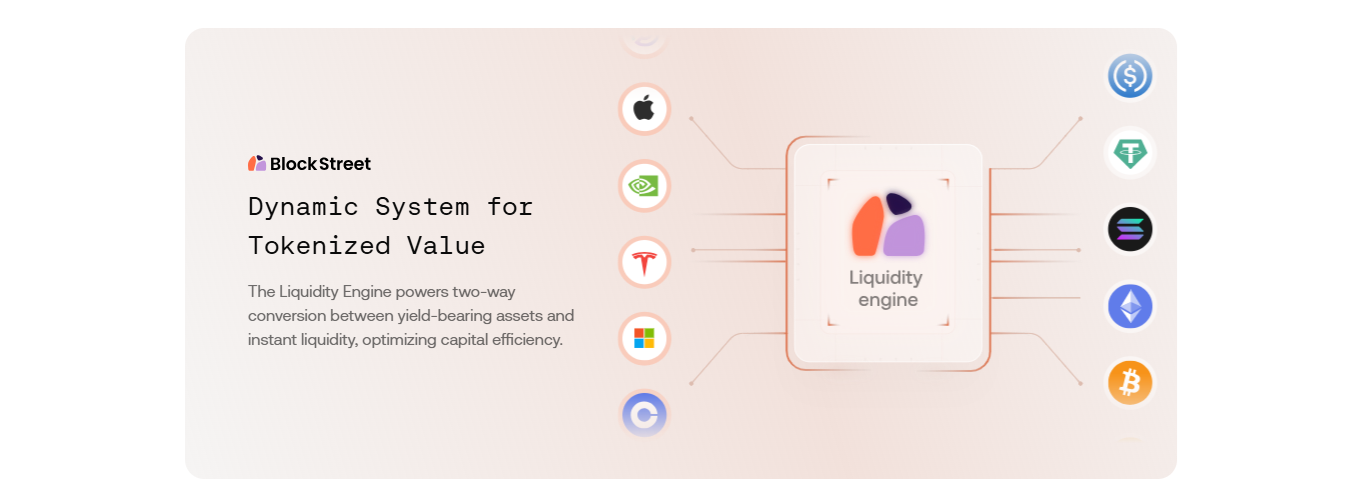
Everst is the protocol that provides leverage and liquidity for tokenized assets. It employs a Hybrid Liquidity Engine that combines off-chain broker-dealer networks with on-chain liquidity pools.
Supported assets include major stocks such as AAPL, TSLA, NVDA, as well as ETFs like SPY and QQQ. The system offers 24/7 trading while enabling collateral reuse to increase capital efficiency.
Overlook on Testnet Performance and Market Validation
Block Street’s testnet reached a total of 700,000 wallets, showing strong user engagement with a 35% retention rate and 41% daily entry rate. These metrics demonstrate that the infrastructure has practical resonance beyond theory.
Block Street (BSB) Tokenomics
$BSB is the economic coordination layer of the Block Street ecosystem. The total supply has been set at 1 billion tokens. Mainnet operates on Ethereum and BNB Chain. The expected circulating supply at TGE is 20.775% (207,750,000 BSB).
Token Distribution
- Community and User Incentives: 22.10%
- Ecosystem Partners: 20.60%
- Exchanges and Marketing: 10.65%
- Treasury: 5.65%
- Team and Advisors: 17.30%
- Lead Investors: 15.70%
- Strategic Investors: 3.00%
- Liquidity: 5.00%
Vesting structures are designed progressively to ensure long-term alignment.
Role of the Block Street (BSB)
- Participation in liquidity mining and incentive programs
- Tiered fee discounts and access to premium execution modules
- Participation in ecosystem programs through staking
- Governance voting (fee structures, risk parameters, asset listing frameworks, treasury usage, etc.)
What is Vision and Roadmap?
As of 2026, Block Street targets the launch of its institutional liquidity network, support for multiple RWA asset classes, and preparation of regulated trading platform infrastructure. The post-2027 vision is to become the standard infrastructure layer for global tokenized asset liquidity.
The project’s target for the end of 2026 is $800 million in monthly trading volume and 60% market share in tokenized stock trading.
Block Street (BSB) Team
Block Street was founded by a highly competent team with deep roots in both traditional finance and crypto. The team consists of engineers and operational experts from leading hedge funds, technology giants, and DeFi platforms. They possess profound expertise in risk management, high-frequency trading systems, and scalable blockchain infrastructure.
Prior to Block Street, team members developed ultra-high-performance trading platforms, launched Layer-1 blockchains from scratch, and built successful ventures that reached unicorn status. This combination of TradFi discipline and crypto-native creativity positions Block Street strongly to deliver high capital efficiency infrastructure for tokenized assets on a global scale.
- Hedy Wong – Co-Founder & CEO

Official Links
In the comment section, you can freely share your comments about the topic. Additionally, don’t forget to follow us on Telegram, YouTube, and Twitter for the latest news and updates.